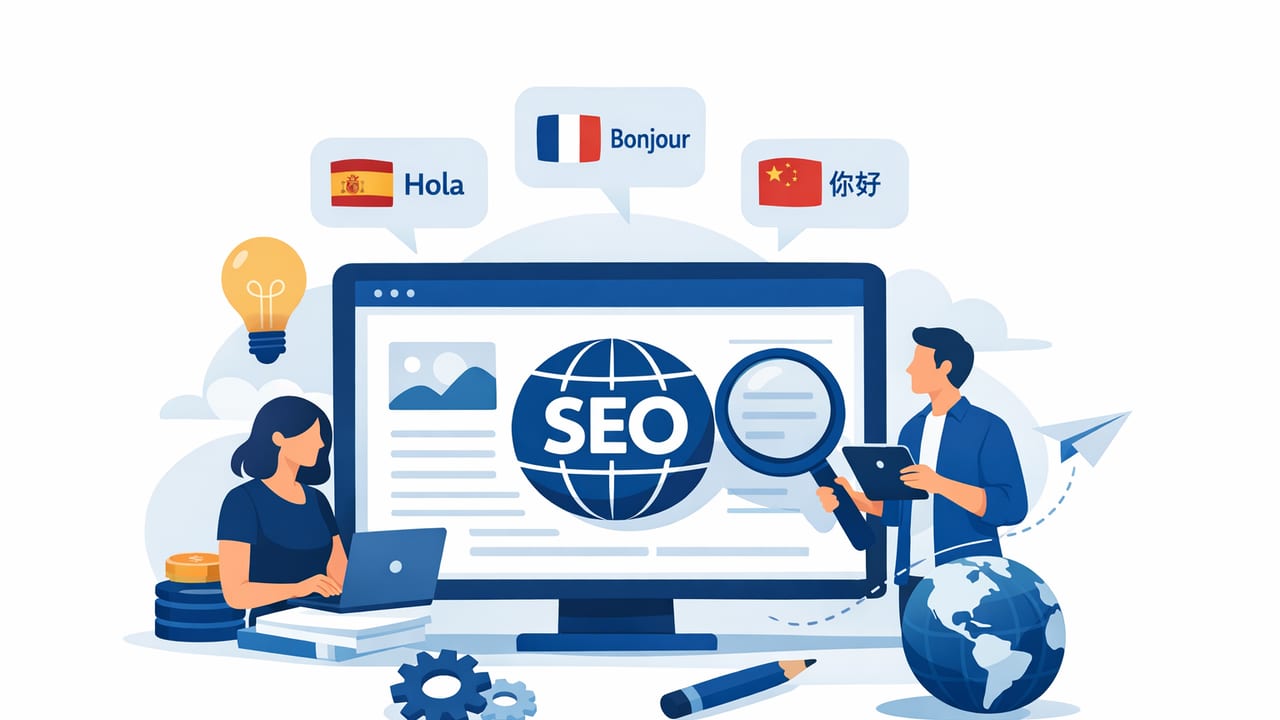
Creating affordable SEO content in multiple languages is one of the fastest ways to expand organic reach without relying on ever-increasing ad spend. But it’s also where many teams waste budget: they translate the wrong pages, target the wrong keywords, and publish language versions that search engines can’t properly crawl or rank.
This guide lays out a practical, budget-aware framework for multilingual SEO content—covering strategy, keyword research, localization, technical setup, and repeatable publishing workflows. The goal is simple: get more qualified traffic from more markets with fewer moving parts.
Why multilingual SEO is different (and why translation alone fails)
Multilingual SEO isn’t “English SEO + translation.” Search behavior, competition, and intent vary by market. A literal translation can miss the phrases people actually search, or fail to match local expectations (currency, examples, tone, units, regulations).
Rule of thumb: translate meaning, localize intent, and optimize for how people search in each language—not how you phrase things in English.
For affordability, the win comes from doing less—but doing it in the right order:
- Choose the right languages and topics (high ROI first).
- Use market-specific keyword research (not direct translations).
- Create reusable templates and QA checks to prevent costly rework.
- Publish consistently with a workflow that doesn’t require manual coordination.
Step 1: Pick languages based on revenue potential and SEO feasibility
“Which languages should we publish in?” is a business question and an SEO question. To keep costs controlled, prioritize markets where you can realistically rank and convert.
A simple scoring model
Create a short list of candidate languages and score each from 1–5:
- Demand: search volume for your category and problems.
- Competition: difficulty of ranking (SERP strength, content depth).
- Conversion fit: do you ship, support, or sell there?
- Operational readiness: customer support, legal, pricing, payments.
- Content leverage: can existing English content be adapted efficiently?
Start with 1–3 languages, validate results, then expand.
Step 2: Build a multilingual keyword plan (without multiplying workload)
The most common budget trap is attempting to mirror the entire English content calendar across every language. Instead, build a shared topic map and a local keyword layer per language.
Topic map (shared across languages)
Define 10–30 core topics that map to your product/service and funnel stages:
- Problem education: “how to…” and “what is…” content
- Solution comparison: alternatives, pros/cons, best tools
- Use cases: by industry, role, company size
- Implementation: setup guides, checklists, templates
Keyword layer (localized per market)
For each language, validate how users actually search. Avoid direct translation as a starting point; use it only to generate initial seeds.
- Seed keywords: translate core concepts + include local terms (e.g., “factura electrónica” vs “e-invoice”).
- SERP review: check what ranks: guides, category pages, forums, video—this reveals intent.
- Cluster keywords: group by intent and page type (blog, landing page, glossary).
- Pick targets: prioritize low-to-mid difficulty, high-intent clusters first.
Affordability tip: you don’t need 200 keywords per language to start. You need 20–40 well-chosen clusters that map to revenue and can be expanded.
Step 3: Decide what to localize vs. what to create new
Not every page deserves full localization on day one. A practical approach is to split content into three tiers:
| Tier | Content Type | Recommended Approach | Why it’s cost-effective |
|---|---|---|---|
| Tier 1 | Money pages (product, pricing, demos, key landing pages) | Professional localization + human QA | Direct conversion impact; mistakes are expensive |
| Tier 2 | High-intent SEO articles (comparisons, “best X,” alternatives) | AI-assisted draft + editor review + localized examples | High ROI; scalable with lightweight review |
| Tier 3 | Top-of-funnel education (glossary, basic how-tos) | Template-based creation + automated QA checks | Volume-friendly; supports internal linking and topical authority |
This tiering keeps your budget focused where quality matters most, while still building enough content breadth to rank.
Step 4: Choose the right URL structure (critical for SEO and maintenance)
For most brands, the most manageable and SEO-friendly option is a language folder structure:
- example.com/en/
- example.com/es/
- example.com/de/
It centralizes domain authority and simplifies analytics compared to separate domains. Subdomains can work, but they often demand more effort to build authority per subdomain.
Implement hreflang correctly
hreflang tells search engines which language/region page to serve. Incorrect hreflang causes duplicate content confusion and wrong-language rankings.
<link rel="alternate" hreflang="en" href="https://example.com/en/how-to-choose-a-crm/" />
<link rel="alternate" hreflang="es" href="https://example.com/es/como-elegir-un-crm/" />
<link rel="alternate" hreflang="x-default" href="https://example.com/" />
Also ensure:
- Each language page references all alternates (reciprocal linking).
- Language pages are indexable (no accidental noindex/canonical mistakes).
- Each language has a crawlable internal link path from navigation or a language selector.
Step 5: Create a repeatable production workflow (the affordability multiplier)
Cost drops when your team follows a consistent system. Here’s a workflow designed for multilingual publishing at scale without sacrificing quality:
- Brief template: primary keyword, intent, audience, outline, internal links to include.
- Draft creation: produce the first version quickly (AI-assisted or writer).
- Localization pass: adjust examples, measurements, spelling conventions, and terminology.
- SEO pass: title, H1/H2, meta description, image alt text, schema (when relevant).
- QA checklist: links work, language is consistent, no mixed-language UI strings.
- Publish + interlink: connect new pages to relevant hubs and money pages.
- Update loop: refresh winners quarterly; prune/merge underperformers.
A lightweight QA checklist (high impact, low cost)
- Intent match: does the page answer what the SERP expects in that language?
- Terminology consistency: glossary terms match across posts.
- Localized CTA: contact, trial, or signup language feels natural.
- Internal links: point to the same-language version wherever possible.
- Formatting: dates, decimals, currencies, and units are localized.
Step 6: Build topical authority per language (without writing hundreds of posts)
Search engines evaluate topical coverage within each language section. You can grow authority efficiently by using a hub-and-spoke model:
- Hub pages: comprehensive guides that define the topic and link out to spokes.
- Spokes: narrower articles that answer one question and link back to the hub.
Start with 3–5 hubs per language and publish 6–10 supporting spokes around each hub. That’s enough to establish a footprint and learn what resonates.
Step 7: Measure what matters (so you don’t overproduce content)
Affordable multilingual SEO is as much about stopping low-performing work as it is about publishing. Track metrics at the language-folder level:
- Index coverage: are pages being discovered and indexed?
- Rank distribution: how many keywords in top 3 / top 10 / top 50?
- Organic conversions: leads, trials, purchases attributed to each language.
- Engagement: scroll depth, time on page, return visits (by market).
After 6–10 weeks, identify:
- Winners: expand clusters, add supporting content, improve internal linking.
- Near-winners: update titles, add missing sections, strengthen E-E-A-T signals.
- Non-starters: merge thin pages into stronger hubs or change the angle to match intent.
Common pitfalls that inflate cost (and how to avoid them)
- Pitfall: translating English keywords directly.
Fix: do SERP-led keyword validation per language. - Pitfall: publishing without hreflang and consistent internal linking.
Fix: implement a technical checklist before scaling. - Pitfall: producing the same volume in every language.
Fix: scale based on results; double down where traction appears. - Pitfall: ignoring localization details (units, legal, cultural context).
Fix: create a market style guide and glossary.
Putting it all together: a 30-day starter plan
- Week 1: choose 1–2 languages, set URL structure, define 3 hubs per language.
- Week 2: build keyword clusters for each hub; create briefs and templates.
- Week 3: publish hubs + 3 spokes per language; add internal links and basic schema.
- Week 4: publish 3–6 more spokes; review indexing, rankings, and engagement.
From there, maintain a steady cadence (even 2–3 posts per week per language can compound) and focus on iterative improvements rather than constant reinvention.
Final thoughts
Affordable multilingual SEO content comes down to a disciplined system: prioritize markets, validate keywords locally, localize intent (not just words), and standardize production with QA. Once that foundation is in place, scaling becomes a question of cadence and consistency—not chaos.
Note: If you want to reduce operational overhead further, a hosted automation platform (for example, the24blog) can help streamline multilingual publishing—just make sure your strategy, localization rules, and technical SEO basics are solid first.