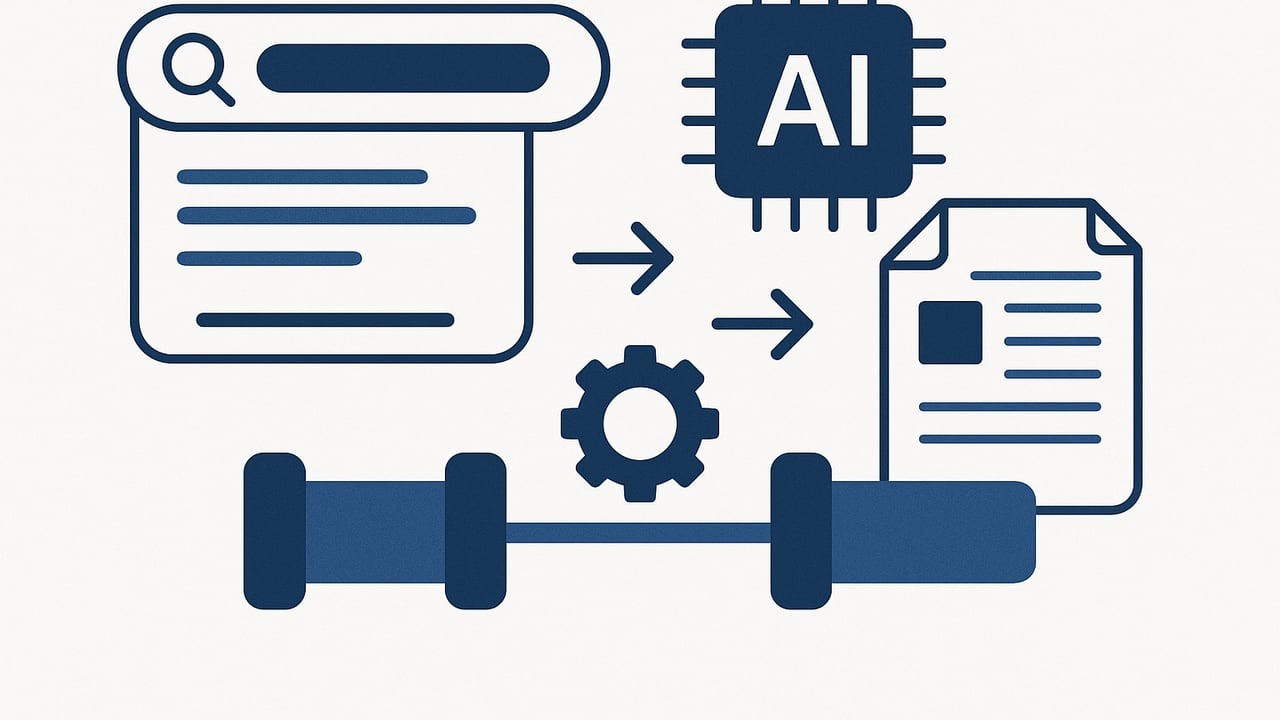
Most teams don’t fail at content marketing because they lack ideas—they fail because prioritization, quality control, and publishing velocity break down at scale. The answer is a unified system that combines AI keyword research with automatic article publishing. Done right, it delivers topic coverage, speed, and consistency while reducing manual overhead.
“Content velocity without quality is noise. Align your research, drafting, and publishing in a closed-loop system.”
This guide shows how to design that system end-to-end: how to discover opportunities with AI, generate briefs that match search intent, and publish reliably via automation—with safeguards so you never trade quality for scale.
How AI Keyword Research With Automatic Article Publishing Works
At its core, this approach unifies three layers: data, decisions, and delivery.
- Data: Collect SERP data, search volumes, keyword variations, questions, and competitor gaps. AI helps expand seed terms into long-tails, cluster themes, and infer intent.
- Decisions: Score and prioritize opportunities by difficulty, traffic potential, business fit, and conversion likelihood. AI can draft briefs and outlines aligned to intent and brand rules.
- Delivery: A scheduling pipeline auto-publishes posts to your CMS, applies templates (schema, internal links, CTAs), and pushes to RSS or social—while running guardrails and QA checks.
The result is a repeatable, measurable workflow that scales your output without inflating your team.
Build the System in 7 Steps
1) Define inputs and seed topics
Start with products, use cases, and pain points. Pull raw terms from customer calls, support tickets, competitor sitemaps, and internal search logs. Feed this seed list into AI for expansion: variants, modifiers, questions, and comparisons. Ensure a balance of bottom‑funnel ("best X for Y"), middle‑funnel ("how to"), and top‑funnel ("what is") queries so your plan maps across the buyer journey.
2) Cluster topics and label intent
Use AI to group keywords by semantic similarity and map each cluster to intent: informational, commercial, transactional, or navigational. Clusters should represent page-level topics—if two keywords suggest distinct intents (e.g., "what is" versus "pricing"), they warrant separate pages. Attach representative terms, People‑Also‑Ask questions, and SERP features (videos, snippets) to each cluster.
3) Prioritize by value, not just volume
Search volume is a vanity metric on its own. Compute an Opportunity Score that incorporates business fit and click potential. A simple model:
Opportunity Score = (Normalized Volume × Click Potential) × Business Fit × (1 − Difficulty)

Where:
- Click Potential approximates organic CTR considering ads/featured snippets.
- Business Fit is a 0–1 value for how closely the topic aligns to your offering.
- Difficulty is a 0–1 estimate (links/domain strength of current SERP winners).
Sort by this score to build an editorial roadmap that actually moves pipeline, not just pageviews.
4) Generate briefs and outlines programmatically
Give your writers or AI models a tight brief per cluster: primary/secondary keywords, intent statement, H2/H3 structure, internal links, and evidence sources. Include disallowed claims, tone, and brand style. You can produce these briefs automatically from your clustering output and SERP analysis, then approve in batches.
brief_id: BRF-0427
primary_keyword: ai keyword research with automatic article publishing
intent: informational
headline: How to Build an AI-Driven Keyword Research & Auto-Publishing Engine
h2s:
  - What the System Includes
  - Step-by-Step Setup
  - Safeguards & Quality Checks
internal_links:
  - /blog/topic-clusters
  - /resources/seo-glossary
sources:
  - https://developers.google.com/search/docs
  - https://schema.org/Article
notes: Emphasize guardrails, human review, E-E-A-T
forbidden_claims:
  - Guaranteed rankings
5) Standardize content templates and on-page SEO
Create reusable templates in your CMS: default H-tag hierarchy, meta patterns, image alt conventions, FAQ blocks, and Article schema. Pre-wire internal link modules that surface related posts by cluster. This keeps every post structurally sound and reduces one-off edits.
6) Automate scheduling and publishing
Connect your content generator to a publishing API or queue. Each approved brief triggers a draft. After automated checks pass (and optional human review), the item is scheduled. A simple publish call could look like this:
curl -X POST https://cms.example.com/api/posts \
  -H "Authorization: Bearer $TOKEN" \
  -H "Content-Type: application/json" \
  -d '{
    "title": "AI Keyword Research With Automatic Article Publishing",
    "slug": "ai-keyword-research-automatic-article-publishing",
    "html": "<h1>...</h1>",
    "status": "scheduled",
    "publish_at": "2025-01-15T10:00:00Z",
    "tags": ["SEO","Automation"],
    "canonical_url": "https://example.com/blog/ai-keyword-research-automation"
  }'
Use webhooks to update your tracker when posts go live, then push URLs to indexing APIs where appropriate and safe.
7) Add guardrails and human-in-the-loop QA
Automate checks for duplicate titles, thin content, missing references, off-brand tone, and PII. Block publish if high-risk flags trigger. Add a lightweight human review for E‑E‑A‑T elements (author expertise, citations), legal claims, and brand compliance. Treat feedback as training data to continuously improve prompts and templates.
Sample Tech Stack
- Data intake: SERP APIs, keyword databases, Search Console exports.
- Processing: Embedding-based clustering, LLM-based intent labeling.
- Brief generation: Prompt templates with system rules and brand style.
- Publishing: CMS API, scheduling queue, webhooks for status.
- QA & governance: Plagiarism checks, toxicity filters, schema validator, link checker.
Manual vs. Automated vs. Hybrid: What’s Best?
| Approach | Pros | Cons | Best For |
|---|---|---|---|
| Manual research & manual publishing | High control, nuanced editorial judgment | Slow, inconsistent, costly at scale | Low-volume, premium thought leadership |
| AI research & automatic publishing | High velocity, consistent structure | Risk of quality drift without guardrails | Catalog coverage, long-tail acquisition |
| Hybrid (AI + human checkpoints) | Best balance of scale and quality | Needs clear SOPs and tooling | Most growth teams and agencies |
Quality Safeguards You Should Not Skip
- E‑E‑A‑T signals: Show author credentials, cite sources, and include expert quotes.
- Fact fidelity: Require evidence URLs for claims; auto-reject unsupported facts.
- Originality: Check for semantic duplication across your own site to prevent cannibalization.
- Intent alignment: Validate that headings answer the query; adjust outline when intent is mixed.
- Internal linking: Auto-insert links to pillar pages and related posts; avoid orphan pages.
- Schema & accessibility: Validate Article schema; ensure image alts and proper heading order.
- Localization readiness: For multilingual rollouts, keep translatable strings separate and add hreflang.
Metrics to Track From Day One
- Content velocity: Posts published per week and time-to-publish from brief approval.
- Indexation: Percentage of URLs indexed within 7/30 days; fix template or crawl issues fast.
- Visibility: Impressions and average position by cluster in Search Console.
- Traffic quality: CTR, engaged sessions, scroll depth, and time-on-page.
- Conversions: Assisted and last-click conversions per cluster, not just per post.
- Content health: Update cadence, freshness, and out-of-date flags.
- Link acquisition: New referring domains to pillar pages.
- Cost per indexed page: Spend divided by successfully indexed posts.
Multilingual and International Considerations
If you plan to scale globally, build internationalization into the system early. Cluster topics per locale rather than blindly translating keywords. In some markets, search behavior and SERP features differ for the “same” query. Generate locale-specific briefs with locally relevant examples, pricing conventions, and measurement units. Publish language variants on dedicated URL structures with hreflang and self-referencing canonicals. Ensure your auto-publishing pipeline carries over translated metadata, schema in the target language, and internal links that point to the same locale. Measure performance by market and adapt your priority score with local difficulty and seasonality.
Common Pitfalls (and Fixes)
- Index bloat: Too many low-value pages. Fix by raising minimum Opportunity Score and consolidating overlapping clusters.
- Content cannibalization: Multiple posts target the same intent. Fix with canonicalization and hub-and-spoke linking; merge when needed.
- Thin or generic copy: Add expert insights, data, and examples; require a minimum evidence count per article.
- Outdated facts: Set freshness reminders and auto-flag posts with time-sensitive details for review.
- Wrong intent: Re-run SERP intent checks; if mixed, split into separate pages or adjust outline headings.
FAQs
How often should I publish?
Consistency beats sporadic bursts. Start with 2–5 posts per week you can maintain with quality. As your QA and templates mature, increase velocity. Monitor indexation and engagement—if either drops, slow down and improve outlines and internal links.
Should I auto-publish without human review?
Use a mixed approach. Auto-publish low-risk informational posts that pass strict checks, but require human review for YMYL topics, competitive comparisons, and pages with legal implications. Keep the review lightweight to preserve speed.
Putting It All Together
Pairing AI keyword research with automatic article publishing isn’t about replacing editors—it’s about giving them leverage. By unifying data, decisions, and delivery with strong guardrails, you can increase coverage, publish faster, and maintain trust. Start small with one cluster, prove the workflow, then scale your templates, QA rules, and dashboards.
When you’re ready to operationalize this system end to end, platforms like the24blog can help streamline multilingual research, automated drafting, and scheduled publishing—so your team can focus on strategy and subject-matter expertise.