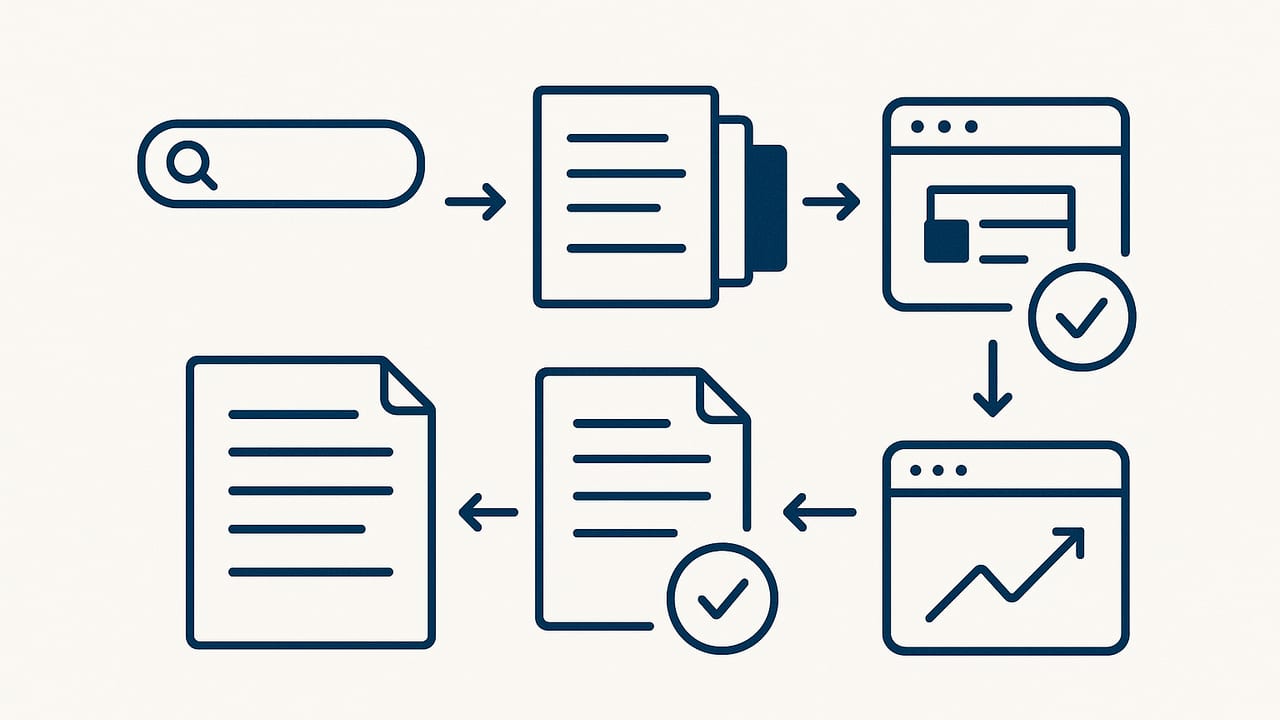
Scaling a blog is no longer about writing more; it is about building a reliable system that discovers opportunities, turns them into publish‑ready articles, and ships on schedule. This guide walks you through a practical, end‑to‑end workflow for automatic keyword research and article publishing, including data collection, clustering, prioritization, content generation, quality assurance, internal linking, and performance tracking.
The goal is simple: create a repeatable pipeline that publishes helpful, search‑optimized content consistently—without sacrificing editorial quality. Whether you are a solo founder, SEO lead, or content ops manager, the framework below helps you automate the busywork and focus on strategy.
Core Components of an Automated Blogging System
- Data sources: Pull terms from Search Console, competitor sitemaps, SERP scraping, People Also Ask, and site search logs.
- Clustering: Group similar queries into topics to avoid cannibalization and plan one page per intent.
- Prioritization: Score topics by traffic potential, difficulty, intent match, and freshness opportunity.
- Briefs: Create tight outlines with headings, angle, schema, target entities, and internal links.
- Drafting: Use AI templates to produce first drafts that follow the brief and your style guide.
- Editorial QA: Human review for fact‑checking, tone, links, and compliance.
- Auto‑publishing: Push approved drafts to your CMS on a schedule with canonical URLs, schema, and images.
- Indexation & monitoring: Submit sitemaps, validate coverage, track ranks, CTR, and conversions.
| Component | Purpose | Key Data | Success Metric |
|---|---|---|---|
| Keyword intake | Collect seed queries | GSC queries, PAA, competitor pages | Coverage of relevant intents |
| Clustering | De‑duplicate & map intent | Embeddings, SERP similarity | 1 topic = 1 URL |
| Prioritization | Pick what to write next | Volume, difficulty, business value | Content impact per post |
| Drafting | Generate on‑brief content | Briefs, brand voice, entities | Editorial acceptance rate |
| Publishing | Ship at cadence | CMS API, schedule, schema | Time‑to‑publish |
| Monitoring | Prove ROI | Rankings, CTR, conversions | Revenue per article |
Step‑by‑Step: From Keyword to Published Article
1) Collect and normalize your keyword inputs
Combine multiple sources to reduce bias: export Search Console queries, crawl competitor sitemaps for topic gaps, scrape People Also Ask, analyze internal site search, and mine community threads (Reddit, Quora) for wording. Normalize by lowercasing, trimming stopwords, and tagging by intent (informational, commercial, transactional, navigational).
2) Expand and cluster by search intent
Generate variants via autocomplete and related searches, then cluster using embeddings or SERP‑based similarity. The outcome is a set of clusters (topics) with a primary keyword, supporting queries, and a single intended URL—your antidote to cannibalization. Aim for one cluster per article.
3) Prioritize with a scoring model
Score each cluster using a weighted formula: potential traffic, estimated difficulty, business value, and freshness opportunity. For example: Priority = 0.4 * Traffic + 0.3 * Business Value + 0.2 * Difficulty Inverse + 0.1 * Freshness. Keep the model simple and review outliers manually.
4) Create compact content briefs
Each brief should include the search intent, target SERP features, H2/H3 outline, entities to cover, examples, internal links to add, external references to cite, and required schema. A tight brief reduces AI drift and speeds up human QA.
5) Generate first drafts with AI templates
Use consistent templates that map to intents: how‑to, comparison, definition, checklist, or case study. Provide the brief, tone guidance, and constraints (word count, required sections). Bake in your linking rules and CTAs. Keep drafts modular so editors can swap sections quickly.
6) Human‑in‑the‑loop editorial review
Automate what you can, but keep humans responsible for accuracy, brand tone, claims, and compliance. Editors validate facts, add unique insights, improve examples, and ensure helpfulness and originality—critical for trust and long‑term rankings.
7) Automatic article publishing via CMS API
Once approved, push articles to your CMS programmatically. Set title, meta, canonical, feature image, Open Graph, internal links, schema, and publication time. Generate and submit an updated XML sitemap and ping indexing endpoints as allowed.
8) Index, measure, and iterate
Monitor coverage, rankings, CTR, and conversions. Feed winning topics and internal search queries back into your intake. Refresh decaying posts, expand sections that gain impressions, and prune thin pages. Your system improves as you close the loop.
Editorial automation is not about cutting corners; it is about cutting friction so humans can focus on judgment, clarity, and originality.
Example: Minimal Automation Script
The example below sketches a thin pipeline that pulls queries, clusters them, generates titles, and schedules posts via a generic CMS API. Swap in your own providers and authentication.
import requests, json, time
from datetime import datetime, timedelta

GSC_TOKEN = "YOUR_GSC_TOKEN"
CMS_TOKEN = "YOUR_CMS_TOKEN"
CMS_API   = "https://cms.example.com/api/posts"

# 1) Pull queries (pseudo: replace with Search Console API)
def get_gsc_queries(site, days=28):
    return [{"query": "best coffee grinder", "clicks": 120, "impressions": 5400},
            {"query": "coffee grinder vs blender", "clicks": 30, "impressions": 1100}]

# 2) Simple clustering by token overlap (placeholder)
def cluster(queries):
    clusters = [{"primary": "coffee grinder", "members": [q["query"] for q in queries]}]
    return clusters

# 3) Generate basic title from cluster
def make_title(cluster):
    return f"Coffee Grinder Buying Guide: Types, Features, and FAQs"

# 4) Post to CMS as draft with schedule
def publish(post_html, title, slug, publish_at):
    payload = {"title": title, "slug": slug, "html": post_html,
               "status": "scheduled", "publish_at": publish_at.isoformat()}
    headers = {"Authorization": f"Bearer {CMS_TOKEN}", "Content-Type": "application/json"}
    r = requests.post(CMS_API, data=json.dumps(payload), headers=headers)
    r.raise_for_status()

queries  = get_gsc_queries("https://yoursite.com")
clusters = cluster(queries)
for i, c in enumerate(clusters):
    title = make_title(c)
    slug  = "coffee-grinder-buying-guide"
    html  = "<h1>" + title + "</h1><p>Draft...</p>"
    when  = datetime.utcnow() + timedelta(days=i)
    publish(html, title, slug, when)
    time.sleep(0.3)
Even a simple script like this proves the plumbing: intake, grouping, generation, and scheduling. You can replace the placeholders with production‑grade services, better clustering, and real briefs.
Prompts and Brief Templates
Use intent‑specific templates to keep outputs consistent.
Brief skeleton:
- Primary keyword and cluster
- Search intent and SERP features to target
- Outline (H2/H3), with word range per section
- Required entities, definitions, examples
- Internal links to add and anchor texts
- External sources to cite
- Schema: Article / HowTo / FAQ
Prompt starter for informational guides:
You are an expert editor. Using the brief below, write a 1,300-word, helpful article.
- Tone: clear, practical, non-promotional.
- Include H2/H3 headings, lists, and a short FAQ.
- Add internal links using the provided anchors.
- Cover required entities and definitions.
- Include a conclusion with a single actionable next step.
BRIEF: <paste structured brief>
Editorial Quality at Scale
Automation is powerful, but quality safeguards are non‑negotiable. Build them into your system:
- Style guide: Tone, formatting, headings, link conventions, and banned claims.
- Fact‑checking: Cite sources, validate stats, and prefer primary data.
- Originality: Require unique examples, screenshots, or micro‑case studies.
- Topical completeness: Cover entities and subtopics surfaced by the SERP and your brief.
- Helpful features: Add checklists, comparison tables, and FAQs aligned to intent.
- Human audit: Randomly sample published posts weekly for a deep review.
To keep pace without bloat, favor focused articles per intent rather than omnibus posts that attempt to rank for everything. Map each cluster to exactly one URL and update that URL over time instead of spawning duplicates.
SEO Details That Compound Results
- Internal linking: Auto‑insert 3–5 contextual links to and from thematically related posts. Maintain a hub and spoke structure.
- Schema: Use Article, HowTo, FAQ, and Product schema where applicable. Validate with a structured data testing tool.
- Media assets: Generate compression‑ready images, set alt text from the brief, and use descriptive file names.
- Canonical and pagination: Ensure canonical URLs and avoid near‑duplicate fragments across languages or regions.
- URL hygiene: Short, descriptive slugs; avoid dates unless necessary.
Measurement and ROI
Define success in advance so you can attribute results to your workflow.
- Leading indicators: Indexed pages, impressions, ranking distribution (Top 3, 4–10, 11–20), crawl stats.
- Lagging indicators: Organic sessions, conversions, revenue per article, and payback period.
- Quality indicators: Editorial acceptance rate, percent of posts updated within 90 days, and link acquisition.
| KPI | Target | Notes |
|---|---|---|
| Time‑to‑publish | < 48 hours from brief to live | Measure friction in your pipeline |
| Acceptance rate | > 90% on first editorial pass | Signals brief quality |
| Top‑10 coverage | 70% of posts within 90 days | Topic selection + quality |
| Revenue per post | Positive within 120 days | Ties to business value score |
Troubleshooting Common Issues
- Cannibalization: If two URLs rank for the same cluster, consolidate into the stronger URL and 301 the weaker one. Tighten your clustering.
- No indexation: Check canonical tags, robots directives, internal links, and sitemap freshness. Improve link depth from hubs.
- Thin content: Expand sections to cover entities and FAQs surfaced by the SERP. Add examples, tables, and references.
- Traffic without conversions: Reassess intent alignment and add stronger internal CTAs. Review your priority model.
- Rank decay: Identify posts with falling impressions. Refresh with new data, updated screenshots, and broader coverage.
Putting It All Together
Automation shines when it is paired with clear strategy and human judgment. Build your pipeline around topics users actually need, enforce editorial standards, and measure what matters. Over time, your system will earn compounding gains: more consistent publishing, better topical coverage, and clearer proof of ROI.
If you prefer a hosted path, platforms like the24blog can streamline the stack by combining research automation, AI drafting, multilingual publishing, and scheduled posts in one place—handy when you want outcomes without maintaining infrastructure.