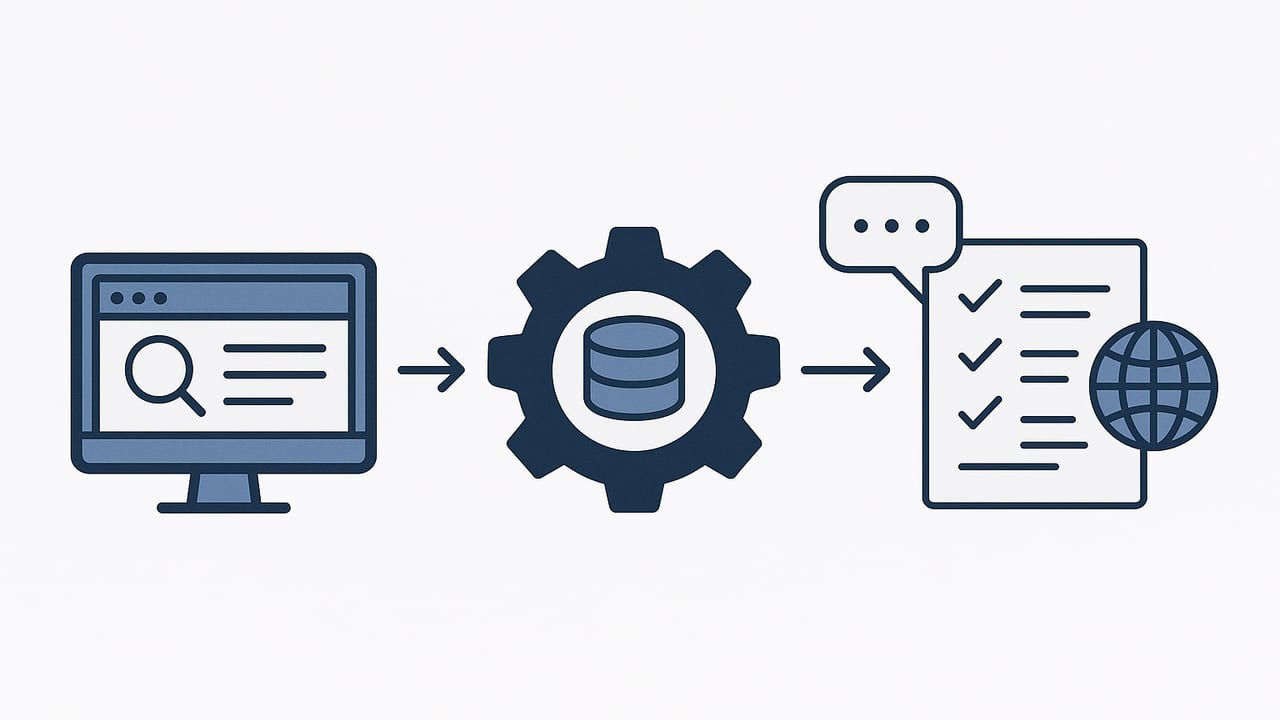
SEO teams are being asked to publish more, faster, and in more languages—without sacrificing quality. That’s where seo content automation comes in: a structured way to research, generate, enrich, review, and publish search‑ready content at scale. This guide walks you through the architecture, workflows, safeguards, and metrics to build an automated engine that consistently earns rankings, clicks, and conversions.
What is SEO Content Automation?
SEO content automation is the systematic orchestration of topic discovery, brief creation, AI-assisted drafting, enrichment (links, schema, images), editorial QA, and publishing—driven by data and repeatable templates rather than ad‑hoc effort. The goal isn’t to replace human judgment. It’s to elevate it, letting machines handle repetitive tasks while humans set strategy, enforce quality, and sign off.
When to Automate vs. Write Manually
- Automate when you have repeatable patterns: product category pages, service/location pages, glossary entries, FAQs, comparisons, feature updates, price pages, and long‑tail how‑tos.
- Write manually for investigative journalism, original research, sensitive YMYL topics, executive thought leadership, and nuanced industry takes requiring firsthand experience or quotes.
- Hybrid for most teams: automated drafts and enrichment, human editing and fact-checking, automated publishing and measurement.
Architecture of a Scalable Automation Engine
Think in layers. Each layer produces structured outputs that feed the next step.
1) Inputs: Data & Intent
- Keyword sets with intent labels (informational, transactional, navigational).
- Entity lists (products, features, locations, competitors, use cases).
- Search evidence (SERP features, People Also Ask, top ranking headings).
2) Templates & Prompts
- Content templates by search intent (guide, comparison, checklist, landing page).
- Prompt frameworks enforcing structure (outline, facts, links, tone, CTA).
3) Generation
- AI generates drafts, headlines, meta tags, FAQs, and image prompts.
- Programmatic sections (tables, pros/cons, feature matrices) produced from data.
4) Enrichment
- Internal links and anchor text suggestions.
- Schema.org markup (Article, FAQPage, Product, HowTo).
- Image suggestions and captions; alt text populated from entities.
5) QA & Governance
- Automated checks (length, plagiarism, broken links, EEAT heuristics).
- Human edit pass (facts, tone, brand compliance, risk).
6) Publishing & Feedback
- Scheduled publishing, sitemaps, and change logs.
- Instrumentation: Search Console, analytics, rank tracking, A/B tests.
Data Sourcing for Topics and Intents
Effective seo content automation starts with reliable inputs:
- Search Console: queries and pages with impressions but low CTR; gap analysis by country and device.
- Keyword tools: cluster by parent topics; tag intent using rules (contains "best" → commercial; "how" → informational).
- SERP scraping: capture People Also Ask questions and top result H2/H3 patterns for outline hints.
- Internal data: customer FAQs, sales objections, chat logs, product taxonomy.
- Competitor diff: compare their hub pages, glossary coverage, and comparison matrix against yours.
Templates and Prompt Frameworks that Scale
Standardize structure to ensure consistency and editable outputs. Here’s a compact prompt pattern you can adapt:
System: You are an SEO editor. Follow the brief exactly. Use factual, brand-safe tone.

User:
Goal: Write a [<content type>] targeting [<keyword>] (intent: [<intent>]).
Audience: [<persona>]. Stage: [<funnel stage>].
Must-cover entities: [<entities>]. Prohibited claims: [<rules>].
Outline (lock): [<H2/H3 structure>].
Internal links (anchor - URL): [<pairs>]. External sources: [<trusted citations>].
Output: title (~60 chars), meta (~150 chars), body (~1200 words), 5 FAQs, schema JSON-LD.
Keep the outline and entities “locked” so the model cannot omit critical sections or invent structure. Use few-shot examples to demonstrate voice and depth.
Programmatic SEO: Turn Data Grids into Pages
Programmatic SEO leverages matrices such as service × location or feature × industry to generate many valuable landing pages. Success depends on unique value per page:
- Local proof (maps, case studies, regulations) for location pages.
- Feature comparisons with quantified deltas and use-case examples.
- Dynamic tables from authoritative datasets (pricing tiers, specs, timelines).
Automate the boilerplate, but inject unique, data-backed content to avoid thin pages.
Multilingual and Localization at Scale
- Translate intent, not just words: adapt examples, units, idioms, and compliance notes.
- hreflang: generate accurate hreflang tags and country mappings.
- Regional SERP parity: re-check competitor pages and featured snippets per locale.
- Glossary consistency: maintain term dictionaries per language to keep terminology stable.
Quality Assurance and Editorial Governance
Automation earns trust only when quality is predictably high and errors are predictably rare.
- EEAT checks: require author bylines, credentials, and experience snippets; add citations for statistics.
- Factuality gate: verify figures and legal statements against trusted sources.
- Originality: run de-duplication against your own site; cite sources; avoid near duplicates across locales.
- Style guardrails: prohibited phrases, reading level, inclusive language.
- Technical: title/meta pixel width, canonical, schema validation, internal link count, image alt coverage.
Measurement: KPIs for Automated Content
- Indexation: percentage indexed in 7/30 days; coverage issues by template.
- Visibility: impressions and average position by cluster and locale.
- Click-through: CTR deltas after meta testing; SERP feature presence.
- Engagement: scroll depth, time on page, next-page path, conversion rate.
- Quality: editorial defect rate, factual corrections, support tickets mentioning content.
Tech Stack Options for seo content automation
| Approach | Pros | Cons | Best for |
|---|---|---|---|
| Spreadsheet + Apps Script | Fast to prototype; accessible; minimal dev | Hard to version control; brittle at scale | Early-stage teams, proof of concept |
| Python pipeline (Airflow/Prefect) | Fully customizable; robust scheduling | Requires engineering; maintenance overhead | Mid–large teams with data/ML support |
| No-code automation (Zapier/Make) | Quick integrations; templates available | Cost scales with volume; limited QA logic | SMBs, marketing-led ops |
| Fully hosted platform | Hands-off hosting, localization, and SEO | Less granular control; vendor dependency | Teams prioritizing speed to value |
Example: Minimal Python Workflow
This lightweight example shows how to transform a keyword CSV into structured drafts with basic safeguards. Replace the model call with your LLM provider.
import csv, json, time
from pathlib import Path

INPUT = "keywords.csv"  # columns: keyword,intent,entities,outline
OUTDIR = Path("drafts")
OUTDIR.mkdir(exist_ok=True)

PROMPT_TMPL = """
You are an SEO editor. Write an article targeting: {keyword} (intent: {intent}).
Must-cover entities: {entities}.
Use this H2/H3 structure: {outline}.
Output JSON with keys: title, meta, body, faqs (list of Q/A), schema (JSON-LD string).
Maximize factual clarity; avoid unverified claims; include internal linking placeholders like [[anchor|/slug]].
"""

def call_llm(prompt):
    # Pseudocode; replace with your provider
    # resp = client.chat.completions.create(model="your-model", messages=[{"role":"user","content":prompt}])
    # return resp.choices[0].message.content
    return "{""title"": ""Example Title"", ""meta"": ""Example meta"", ""body"": ""..."", ""faqs"": [], ""schema"": ""{}""}"

with open(INPUT) as f:
    reader = csv.DictReader(f)
    for row in reader:
        prompt = PROMPT_TMPL.format(**row)
        raw = call_llm(prompt)
        try:
            data = json.loads(raw)
        except json.JSONDecodeError:
            continue  # or retry/backoff
        # Simple QA gates
        if len(data.get("title","")) > 70 or len(data.get("meta","")) > 160:
            continue
        if "http://" in data.get("body",""):
            continue  # block insecure links
        slug = row["keyword"].strip().replace(" ", "-")[:60]
        (OUTDIR / f"{slug}.json").write_text(json.dumps(data, ensure_ascii=False, indent=2))
        time.sleep(1)
Extend this with plagiarism checks, schema validation, internal link injection, and a publisher that pushes to your CMS via API.
Common Pitfalls and How to Avoid Them
- Thin duplication: Using the same template without unique data. Fix: require locale insights, proprietary stats, or quotes per page.
- Hallucinated facts: Uncited claims. Fix: restrict to provided sources; add a fact checklist and citation step.
- Over‑indexing on volume: Too many low‑intent pages. Fix: prioritize by expected business impact, not keyword count.
- Broken internal linking: orphaned content. Fix: automate link suggestions by cluster and validate link health in QA.
- Meta and schema drift: titles that truncate; invalid JSON-LD. Fix: enforce pixel and JSON validators in the pipeline.
Launch Checklist
- Define clusters with intent and success KPIs.
- Lock templates and prompt frameworks with examples.
- Implement automated QA (length, links, schema, originality).
- Set human editorial sign-off for sensitive topics.
- Publish in batches; verify indexation and internal links.
- Monitor Search Console; run meta and headline tests.
- Iterate templates based on engagement and conversions.
Putting It All Together
Effective seo content automation isn’t about pressing a button; it’s about building a system that turns data into dependable, differentiated content. Start with one cluster, ship a tight template, wire in QA, measure rigorously, and scale what works. Whether you assemble a pipeline with spreadsheets and scripts or adopt a hosted solution, the winning pattern is the same: clear intent, rigid structure, unique value, and feedback loops that never stop learning.
If you prefer a hosted, hands‑free approach that handles multilingual publishing and daily scheduling without WordPress overhead, platforms like the24blog can operationalize much of this playbook while you focus on strategy and quality.