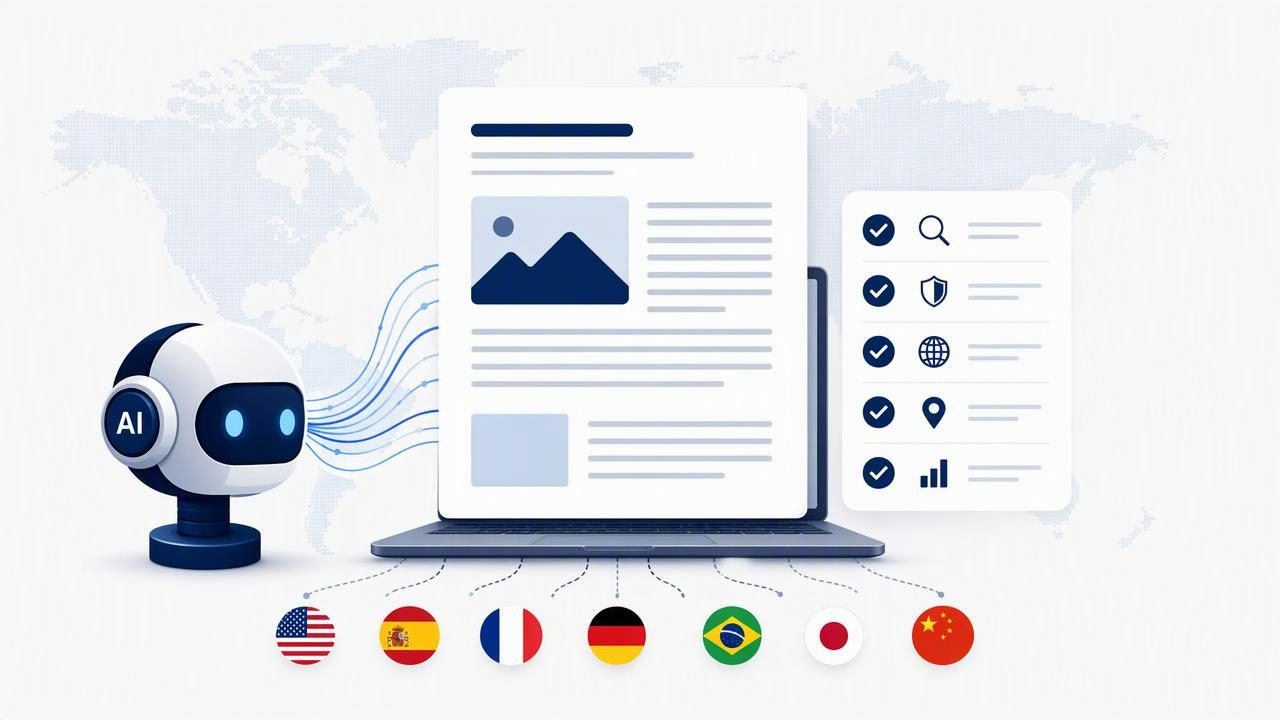
Publishing in multiple languages can turn a strong local content strategy into a global growth engine. It can also create a mess of duplicated pages, awkward translations, inconsistent terminology, and missed search opportunities when it is handled without a process.
The key is not simply translating an existing blog post word for word. To create multilingual articles that earn visibility, trust, and conversions, each piece must be adapted for how people in a specific market search, read, and make decisions. An AI content engine can make this work dramatically faster, but only when it is guided by reliable inputs, editorial rules, and SEO checks.
This practical checklist explains how to build a repeatable multilingual content workflow that balances automation with quality control.
Why Multilingual Content Needs More Than Translation
Translation answers the question, “How do we say the same thing in another language?” Localization answers a more useful question: “What information does this audience need, and how do they naturally look for it?”
For example, an English-language searcher may look for “best project management software,” while a French audience may use a more specific phrase related to collaboration tools, pricing, or small businesses. Even when the intended topic is similar, the search intent, preferred terminology, examples, and buying considerations can differ.
A high-performing multilingual article should account for:
- Local keyword behavior: Search volume and phrasing vary by country and language.
- Search intent: Users may want a guide, comparison, definition, or product page.
- Cultural context: Examples, currencies, dates, measurements, and references should feel familiar.
- Regional accuracy: Legal, financial, health, and compliance information may differ by market.
- Technical SEO: Search engines need clear language and regional targeting signals.
AI-powered blogging helps teams scale production, but it should support a localization strategy rather than replace one.
The Multilingual Article Creation Checklist
Use the following checklist before, during, and after generating content with an AI content engine. It is designed for businesses that want to publish consistently without losing editorial control.
1. Define the Market, Language, and Audience
Start by defining exactly who each article is for. “Spanish” is not always specific enough. Spanish readers in Mexico, Spain, Argentina, and the United States may use different vocabulary and have different search behavior. The same is true for English in the United Kingdom, United States, Canada, and Australia.
Create a content brief with the following information:
- Target country or countries
- Primary language and regional variant
- Audience role, industry, and awareness level
- Primary goal: traffic, leads, education, sign-ups, or sales support
- Local competitors and trusted publications
- Relevant local requirements or restrictions
Clear market definitions prevent a common automation mistake: producing one generic translated page and assuming it will serve every region equally well.
2. Research Keywords Separately for Every Language
Never assume that a direct translation of an English keyword is the best keyword in another language. A translated term may have little search volume, sound unnatural, or reflect a completely different intent.
Instead, research a primary keyword and supporting terms for each target market. Look beyond volume alone. Prioritize phrases that match your expertise and fit the stage of the buyer journey.
| Keyword Factor | What to Check | Why It Matters |
|---|---|---|
| Natural phrasing | How native speakers actually search | Improves relevance and readability |
| Intent | Informational, commercial, navigational, or transactional | Helps match the right content format |
| Local competition | Pages ranking in the target country | Shows expected depth and angle |
| Semantic terms | Related questions, entities, and phrases | Builds topical completeness |
| Difficulty and value | Ranking effort compared with business relevance | Supports smarter prioritization |
An automated keyword research process can identify opportunities at scale, but a human should still review high-priority terms for context and brand fit.
3. Build a Localized Content Brief Before Generation
A detailed brief gives an AI content engine the context it needs to produce useful drafts. Without one, AI may default to broad, generic explanations that fail to distinguish your brand or address local needs.
Your brief should include the target keyword, user intent, article angle, preferred word count, outline, internal links, credible sources, and brand voice instructions. Add language-specific guidance too, such as preferred spellings, formal or informal pronouns, prohibited phrases, and terms that must remain untranslated.
Tip: Treat the original-language article as source material, not as an unchangeable template. The best localized version may need a different introduction, examples, headings, or conclusion.
4. Give AI a Strong Prompt Framework
Consistency is essential when you publish dozens or hundreds of multilingual blog posts. A reusable prompt framework makes outputs easier to review and keeps each article aligned with your standards.
Write a helpful SEO article for [country] readers in [language variant].
Primary keyword: [keyword]
Search intent: [intent]
Audience: [audience]
Use natural local terminology and a [tone] tone.
Include practical examples relevant to [market].
Avoid literal translations, unsupported claims, and keyword stuffing.
Use clear headings, short paragraphs, and a concise FAQ.
This type of structure helps an AI writing workflow maintain quality while allowing market-specific variables to change. It also makes it easier to document and improve your content operations over time.
5. Localize Examples, Data, and Calls to Action
Readers notice when content was written for someone else and merely translated for them. Replace references that do not fit the target market. That may include currencies, regulations, brands, units of measurement, seasonal references, contact details, and customer stories.
For example, a guide for U.S. small businesses may discuss dollars and federal tax deadlines. A version for Germany may need euro pricing, different business structures, and locally relevant examples. These changes improve usefulness and make the article more credible.
Calls to action should also reflect the market. A direct “Start your free trial today” may work well in one region, while an educational invitation such as “Explore the guide” can feel more appropriate in another.
6. Preserve Brand Terminology and Subject Accuracy
AI can generate polished language, but it does not automatically know which product names, claims, legal statements, or industry terms your organization has approved. Build a multilingual glossary that includes:
- Product and feature names
- Approved brand descriptions
- Industry-specific terminology
- Words that should never be translated
- Preferred translations and unacceptable alternatives
- Required disclaimers for regulated topics
For technical, medical, legal, or financial content, use qualified native-language reviewers. AI is useful for acceleration, but subject-matter accuracy must remain a human responsibility.
7. Optimize On-Page SEO for Each Version
Every localized page needs its own SEO elements. Do not copy the same title tag and meta description across all language versions. Write them naturally in the target language and include the localized primary keyword when it fits.
Review each page for:
- A unique, localized title tag and meta description
- One clear H1 aligned with search intent
- Logical H2 and H3 headings using related terms
- Descriptive image alt text in the correct language
- Internal links to relevant pages in the same language
- Readable URLs that follow your site’s localization structure
- Natural keyword placement rather than repetition
Avoid automatically linking readers from a localized article to an unrelated English landing page. A broken language journey can reduce trust and weaken conversion rates.
8. Implement Hreflang Correctly
Hreflang annotations help search engines understand which version of a page is intended for which language or region. They can reduce the chance of a user in one market seeing the wrong localized version in search results.
A simplified example looks like this:
<link rel="alternate" hreflang="en-us" href="https://example.com/us/article/" />
<link rel="alternate" hreflang="fr-fr" href="https://example.com/fr/article/" />
<link rel="alternate" hreflang="x-default" href="https://example.com/article/" />
Use valid language-country codes, ensure each version references the others, and include a self-referencing annotation. Hreflang is not a substitute for good localization, but it is an important technical layer of international SEO.
9. Run a Native-Language Quality Review
Before publishing, have a native speaker review important articles, especially pages that target high-value keywords or discuss sensitive topics. The reviewer should assess more than grammar.
- Does the article sound natural rather than translated?
- Are local terms accurate and appropriate?
- Do examples make sense for the audience?
- Are claims specific, current, and supportable?
- Does the tone match the brand and market?
- Are links, forms, and calls to action relevant?
For lower-priority informational content, consider a tiered review model: automated checks first, editorial sampling second, and deeper human review for pages showing meaningful traffic or conversion potential.
10. Measure Performance by Market, Not Just Total Traffic
Multilingual content programs improve when reporting is segmented. Monitor impressions, clicks, rankings, engagement, conversions, and assisted conversions for each language and country. A page may receive fewer visits in a smaller market while delivering much stronger lead quality.
Review performance monthly and use the findings to update your content strategy. Expand successful topic clusters, refresh pages losing visibility, improve weak internal linking, and identify languages where localized keyword research reveals new opportunities.
A Repeatable Workflow for Scalable Multilingual Publishing
The most efficient process combines automation with clear decision points. AI can handle repetitive research, outlining, drafting, formatting, and publishing tasks. People should guide positioning, approve sensitive facts, protect brand standards, and evaluate market fit.
A practical workflow looks like this:
- Select markets based on audience demand and business priorities.
- Research localized keywords and map them to search intent.
- Create market-specific briefs and glossary rules.
- Generate structured drafts with an AI content engine.
- Localize examples, metadata, internal links, and calls to action.
- Review quality, accuracy, and technical SEO.
- Publish with correct language targeting and monitor results.
- Use performance data to improve future content automatically and editorially.
Final Thoughts
Creating multilingual articles is not about producing more pages for the sake of scale. It is about making your expertise accessible and valuable to people who search, read, and buy in different languages. With localized keyword research, strong briefs, careful review, and reliable technical SEO, an AI content engine can make that process sustainable.
For teams seeking a more hands-free way to manage multilingual SEO publishing, platforms such as the24blog can help automate content workflows while keeping the broader strategy focused on relevance, consistency, and global audience reach.