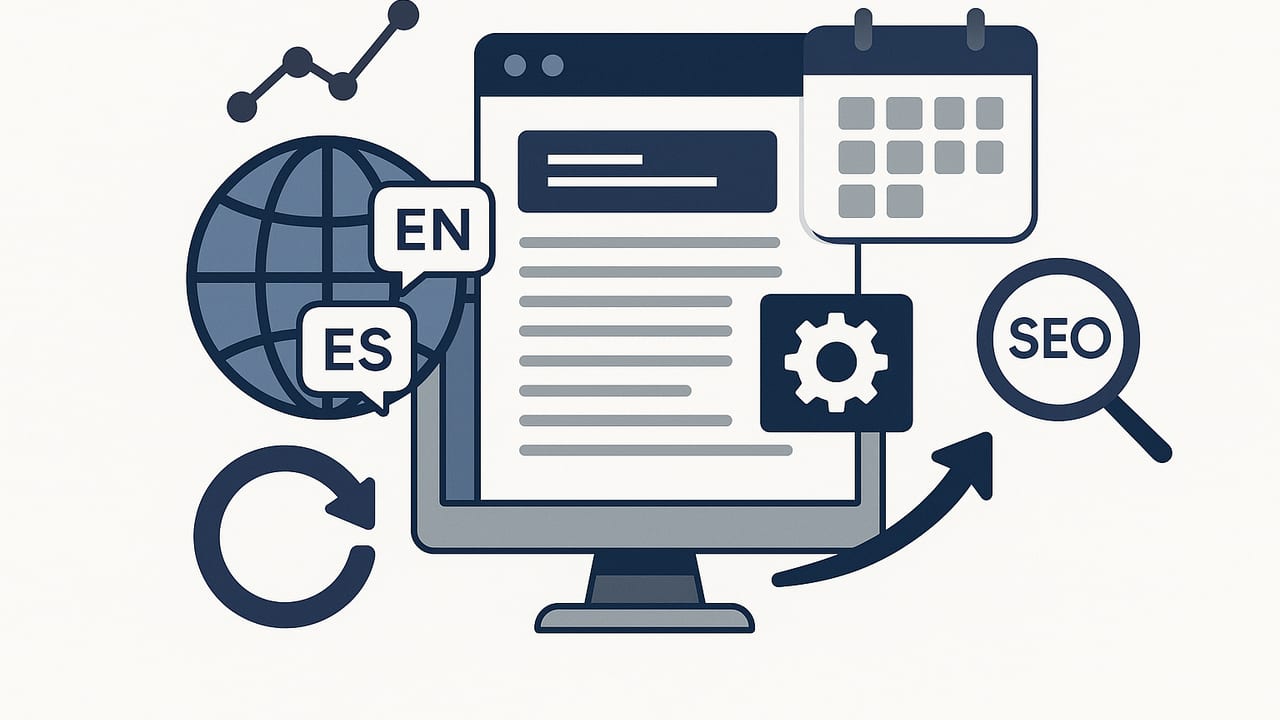
Scaling a daily auto publishing blog in multiple languages is one of the fastest ways to compound search visibility, build topical authority across regions, and reach new revenue streams. Yet doing it right requires more than flipping on an AI switch. You need a durable workflow that pairs automation with editorial judgment, localization with technical SEO, and volume with quality controls. This guide lays out a practical framework to plan, ship, and optimize a multilingual, auto-published blog at scale.
What daily auto publishing really means
Daily auto publishing is not just a scheduler firing posts every 24 hours. It is a system that programmatically discovers opportunities, generates or localizes content, enforces brand and quality standards, and publishes consistently while signaling freshness to search engines. When extended to multiple languages, the system must map topics and intent to each locale, handle regional variants (for example, fr-FR vs fr-CA), and expose the correct language version to the right user with hreflang.
Done well, you get compounding benefits: more entry points to your site, better coverage of the long tail, improved crawl efficiency via structured sitemaps, and stronger engagement through culturally aligned content. Done poorly, you risk thin content, duplicate clusters across languages, cannibalization, and index bloat.
Architecture for a multilingual auto-publishing pipeline
Think of your system as a conveyor belt with clear gates and feedback loops:
- Discovery: Keyword and entity mining per locale, SERP intent mapping, competitor gap analysis.
- Planning: Topic clustering, calendar generation, internal link targets, schema opportunities.
- Creation: Net-new content in the source language or direct generation per locale.
- Localization: Translation with tone adaptation, glossary enforcement, regional examples.
- QA: Automated checks (links, length, templates, banned terms) plus human spot audits.
- Publish: Templated pages, hreflang, canonical tags, sitemap updates, internal links.
- Monitor: Index coverage, impressions, CTR, crawl stats, and regression alerts.
Keyword research per locale: beyond direct translation
A common failure mode is translating English keywords verbatim. Search intent varies by market. Instead:
- Seed by entity, not exact phrasing: Start with products, problems, use cases, and adjacent topics. Expand via local autosuggest, PAA boxes, and marketplace terms.
- Map intent by country: For the same topic, SERPs in Germany may prefer how-to guides, while Mexico leans toward comparisons. Match content types to observed intent per locale.
- Cluster by meaning: Group semantically similar queries in each language. Build one comprehensive piece per cluster to minimize cannibalization.
- Localize modifiers: Prices, seasons, regulations, and examples differ. Include region-specific modifiers to improve CTR and relevance.
Style guides and glossaries keep your voice consistent
Create a per-language style guide and glossary. Define tone (formal, neutral, friendly), banned terms, and preferred translations for key terminology. Lock these into your generation and translation memory so the voice remains consistent across the daily cadence.
SEO foundations for multilingual auto publishing
URL structure and hreflang
Pick a scalable structure such as subfolders per locale: /en/, /es/, /fr-fr/. Implement self-referencing canonicals and hreflang alternates for every language and region pair, plus an x-default for language selectors or global pages.
<!-- Example head tags for a localized article -->
<link rel='canonical' href='https://example.com/es/guia/' />
<link rel='alternate' href='https://example.com/es/guia/' hreflang='es' />
<link rel='alternate' href='https://example.com/es-mx/guia/' hreflang='es-MX' />
<link rel='alternate' href='https://example.com/en/guide/' hreflang='en' />
<link rel='alternate' href='https://example.com/fr-fr/guide/' hreflang='fr-FR' />
<link rel='alternate' href='https://example.com/guide/' hreflang='x-default' />
Ensure that every alternates set is reciprocal. If one locale references another, the target must reference back. Automate tests to flag missing or mismatched pairs before publishing.
Sitemaps and scheduling
Maintain a sitemap index with per-locale sitemaps to guide crawl. Update lastmod on the exact minute of publish. Keep daily frequency predictable to train crawlers.
<?xml version='1.0' encoding='UTF-8'?>
<sitemapindex xmlns='http://www.sitemaps.org/schemas/sitemap/0.9'>
  <sitemap>
    <loc>https://example.com/sitemaps/sitemap-en.xml</loc>
    <lastmod>2025-01-12T09:30:00+00:00</lastmod>
  </sitemap>
  <sitemap>
    <loc>https://example.com/sitemaps/sitemap-es.xml</loc>
    <lastmod>2025-01-12T09:30:00+00:00</lastmod>
  </sitemap>
</sitemapindex>
Internal linking at scale
Auto-generate internal links based on topical clusters and parent pillars. Each new post should link to its pillar and 2–3 related cluster pages. Keep locale links internal to the same language, and rely on hreflang for cross-locale discovery. Avoid orphan pages by enforcing a minimum inbound link count per URL.
E-E-A-T signals you can automate
- Author pages: Associate posts with verified author entities and structured data.
- Citations: Link to reputable sources per locale. Rotate local sources for credibility.
- Review notes: Include a reviewed-on date and reviewer role when applicable.
- Policy pages: Localized privacy and terms pages, linked in the footer per locale.
An automation workflow that ships daily without surprises
Below is a minimal but robust pipeline. It separates generation, localization, QA, and publish into deterministic steps with retry logic.
# Pseudocode for a multilingual auto-publishing pipeline
queue = discover_topics(locales=['en','es','fr-fr'], cadence='daily')

for topic in queue:
    plan = cluster_and_outline(topic)
    draft = generate_content(plan, locale=topic.locale, style_guide=topic.locale)
    localized = localize_if_needed(draft, target_locale=topic.locale, glossary=topic.glossary)
    qa = run_checks(localized, checks=['length','links','brand','pii','render','hreflang'])
    if qa.passed:
        url = publish(localized, schedule=topic.publish_at)
        update_sitemaps(url)
        link_to_pillars(url)
        notify_search_engines(url)
    else:
        escalate_to_editor(topic, qa.issues)
Key details to bake in:
- Idempotency: Re-running a job should not duplicate URLs. Use stable slugs and content hashes.
- Templates: Standardize headings, table of contents, schema, and CTAs so every locale follows best practices.
- Backoff and retries: If a QA check fails or an API times out, retry with exponential backoff and clear logging.
Quality assurance that scales
Automated QA can catch most issues before they ship:
- Structural checks: Word count, headings hierarchy, presence of intro and conclusion, alt text, and table usage.
- Language checks: Profanity/banned term scan, locale-specific spellings, date and number formats.
- SEO checks: Unique title and meta, keyword coverage per cluster, canonical and hreflang completeness, internal link targets.
- Rendering checks: Lighthouse snapshots for CLS/LCP outliers, broken image detection, and mobile viewport.
Pair automation with human-in-the-loop sampling. For new locales or sensitive topics, require editorial review for the first 20–50 posts, then taper to a rolling 5–10 percent spot check. Use a shared glossary plus style guide to keep reviewers aligned.
Freshness without index bloat
Daily cadence does not always mean net-new URLs. Mix new posts with targeted updates to existing winners:
- Update rotations: Refresh 10–20 percent of top performers monthly with new data, examples, and FAQs.
- Consolidate: Merge underperforming near-duplicates and redirect to the canonical winner.
- De-index thin pages: If a locale lacks demand for a topic, exclude it rather than forcing parity.
“Scale is only a moat when quality, intent match, and technical hygiene scale with it.”
Measuring what matters
Track KPIs at the locale and cluster levels:
- Index coverage: Valid vs discovered-not-indexed, per sitemap and per locale.
- Impressions and CTR: Query-level changes for target clusters; watch SERP feature gains.
- Crawl stats: Average response times, crawl requests per day, and crawl budget shifts after major releases.
- Conversion and engagement: Locale-specific goals, scroll depth, and time on page for content types.
Set up separate Search Console and analytics views per subfolder. Use server logs to verify that sitemaps are actually shaping crawl and that daily releases are discovered within 24–48 hours.
Build vs buy: choosing your platform
You can roll your own stack, buy a hosted platform, or run a hybrid. Each path has trade-offs.
| Option | Pros | Cons | Best for |
|---|---|---|---|
| Build in-house | Max control, custom workflows, data ownership | Higher engineering cost, longer time to value, maintenance burden | Teams with dev resources and unique needs |
| Hosted platform | Fast launch, managed SEO basics, integrated localization, scheduling | Less low-level control, vendor dependency | Lean teams needing speed and reliability |
| Hybrid | Control core parts, outsource commodity layers (sitemaps, hreflang, scheduling) | Integration complexity, shared responsibility | Mid-size orgs balancing agility and control |
A 30-day launch checklist
- Week 1: Choose URL structure; create locale folders; set up Search Console per locale; draft style guides and glossaries.
- Week 2: Build topic clusters per locale; create content templates; implement hreflang, canonical, and sitemap scaffolding.
- Week 3: Implement the automation pipeline; wire QA checks; produce 10 pilot posts per locale; run human reviews.
- Week 4: Turn on the scheduler for 1 post per day per locale; monitor indexing; tune internal links; set alerting for errors.
Common pitfalls to avoid
- Translating intent literally: Always validate the local SERP. Adjust format and angle to match.
- Hreflang loops and gaps: Automate reciprocal checks and log any missing alternates before publishing.
- Overproduction without consolidation: Periodically prune or merge overlapping articles.
- Ignoring regional variants: Treat es-ES and es-MX as separate if SERPs and vocabulary differ.
- Thin media: Add tables, examples, and imagery. Structured richness reduces pogo-sticking.
- No feedback loop: Use analytics and Search Console data to refine clusters and templates.
Putting it all together
To run a daily auto publishing blog in multiple languages that actually ranks, align three pillars: localized research and planning, rigorous technical SEO, and a dependable automation pipeline with QA. Start narrow with a couple of locales, lock in the workflow, and scale once you see consistent indexing and engagement. If you prefer a fully hosted, hands-free option, a platform like the24blog can automate research, multilingual generation, and daily publishing while keeping SEO fundamentals intact.