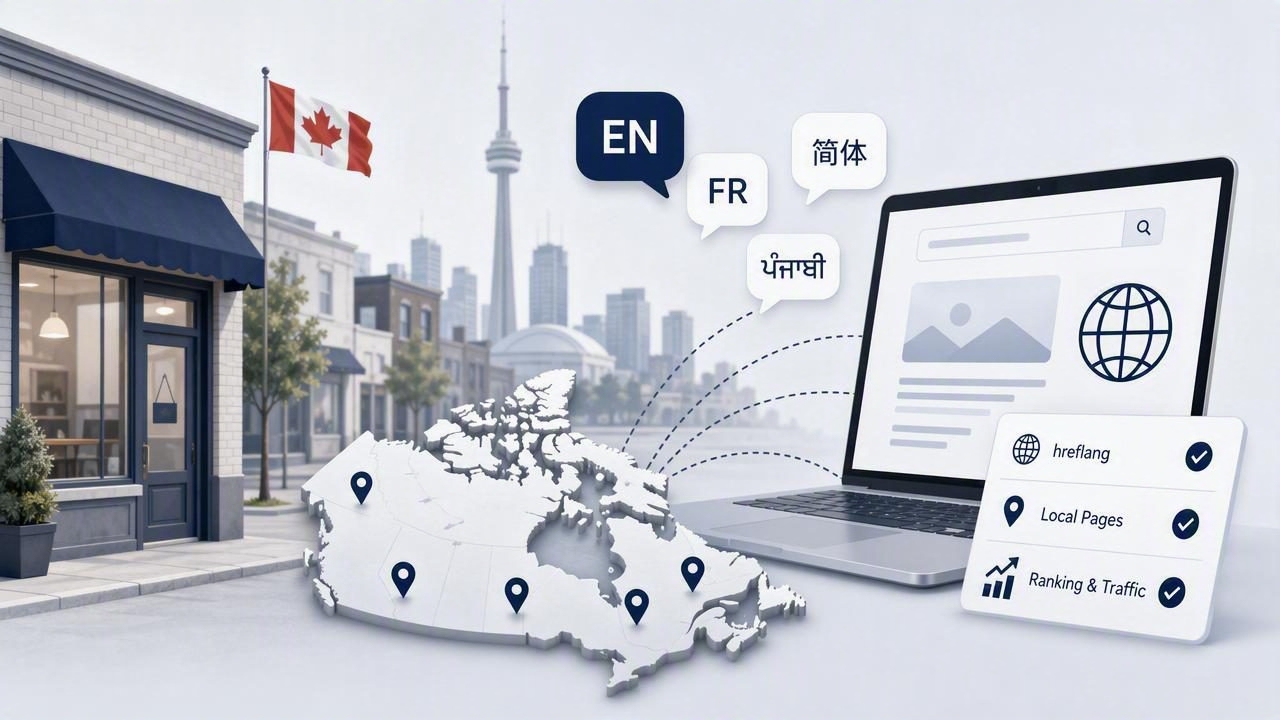
Canada is one of the most linguistically diverse local markets in the world. If you run a clinic, restaurant, law firm, trades service, or retail shop, the right multilingual content for local businesses in Canada can increase visibility in local search, build trust faster, and improve conversion rates—especially on mobile where users decide quickly.
This guide walks through a practical, SEO-first approach to choosing languages, building localized pages, implementing hreflang correctly, and operating a repeatable content workflow that scales across neighborhoods and provinces.
Why multilingual local SEO matters in Canada
Multilingual content isn’t just “nice to have.” For many Canadian communities, it’s directly tied to purchase intent. People often search in the language they’re most comfortable using—especially for high-trust services (healthcare, legal, childcare) and high-frequency purchases (food, home services).
- Search demand exists in multiple languages: Users search in English and French, plus community languages like Punjabi, Chinese, Arabic, Tagalog, Spanish, and more.
- Language signals trust: A localized service page that reads naturally can outperform a generic English page for the same query in the same city.
- Local intent is language-specific: “near me” equivalents, neighborhood names, and service terms vary by language and region.
Localization isn’t translation—it’s matching how people actually search and make decisions in a specific place.
Step 1: Choose languages based on local demand (not assumptions)
The fastest way to waste effort is to add languages without proof of demand. Instead, select languages using a blend of local data and search signals:
- Look at customer data: Ask front-desk staff, review messages, inquiry forms, and call logs.
- Check neighborhood demographics: City and provincial datasets can help validate which languages are prevalent near your service area.
- Validate with keyword research: Use tools (or Search Console if you already rank) to confirm non-English queries exist for your category + city.
Language prioritization table (starter framework)
| Region / City Cluster | Common High-Impact Languages (besides English) | Where it often works best |
|---|---|---|
| Quebec (Montreal, Quebec City) | French | All local categories; especially healthcare, legal, government-adjacent services |
| Greater Toronto Area | French, Punjabi, Chinese (Simplified/Traditional), Urdu, Tamil, Tagalog | Restaurants, clinics, immigration/legal, home services, education |
| Metro Vancouver | Chinese, Punjabi, Tagalog, Korean | Real estate, clinics, home services, finance, local retail |
| Calgary / Edmonton | Punjabi, Tagalog, Arabic | Trades, clinics, community services, local retail |
| Ottawa / Gatineau | French | Government-adjacent services, professional services, healthcare |
Tip: Start with 1–2 additional languages you can support well. Depth (quality + coverage) beats breadth (many languages with thin pages).
Step 2: Decide what to localize (and what not to)
Not every page needs to exist in every language. Prioritize pages that directly drive leads or visits:
- Core service pages: “Dental cleaning,” “family lawyer,” “furnace repair,” etc.
- Location pages: City + neighborhood pages (when they represent real service areas).
- High-intent FAQs: Pricing, insurance/coverage, wait times, service area boundaries.
- Contact + booking pages: These often have the highest conversion impact when localized.
Pages that often don’t need full translation at first:
- Press releases and internal policy pages (unless required for compliance).
- Low-intent blog posts that aren’t tied to local conversion.
Step 3: Translation vs. localization (the conversion difference)
For multilingual content to perform, it must read naturally and reflect local realities. Localization typically includes:
- Local terminology: A “family doctor” vs. “general practitioner” nuance can matter, as can community-specific words.
- Currency, units, and formatting: CAD pricing, metric units, local date formats.
- Service proof: Local references (neighborhoods served, travel fees, parking info) that users recognize.
- Compliance and sensitivity: Especially in healthcare, finance, and legal categories.
Step 4: Build the right site structure for multilingual local SEO
Your URL structure and indexing choices affect how Google discovers and ranks language versions. Common patterns:
- Subdirectories:
/fr/,/zh/(often the simplest to manage) - Subdomains:
fr.example.com(works, but can add operational complexity) - Separate domains: Usually unnecessary for local businesses unless you operate as distinct entities
Use hreflang to prevent duplication and send the right users to the right page
Hreflang tells search engines which language/region version to show. Here’s a minimal example for English and Canadian French pages:
<link rel="alternate" hreflang="en-CA" href="https://example.com/toronto-plumbing/" />
<link rel="alternate" hreflang="fr-CA" href="https://example.com/fr/plomberie-toronto/" />
<link rel="alternate" hreflang="x-default" href="https://example.com/toronto-plumbing/" />
Rules that matter:
- Hreflang must be reciprocal (each version references the others).
- Each language page should be indexable (not blocked by robots or noindex).
- Don’t mix languages on one page; keep one primary language per URL.
Step 5: Local SEO fundamentals still apply (in every language)
Multilingual pages won’t help if local signals are weak. Make sure these are consistent:
- NAP consistency: Name, Address, Phone should match across your site, Google Business Profile, and citations.
- Localized titles and headings: Include service + city in the target language where it’s natural.
- Internal linking: Link between language versions and to key conversion pages.
- Review strategy: Reviews in multiple languages can lift conversions (don’t fake them; focus on customer experience).
On-page SEO checklist for each language page
- Title tag: Service + city + value prop (localized)
- H1: Clear and matching intent
- Intro paragraph: Confirm service area and top service in the first 100 words
- FAQ section: 4–8 high-intent questions in the target language
- Conversion CTA: Call/booking button text localized
- Schema markup: LocalBusiness + Service where relevant
Step 6: Create a multilingual keyword map (so pages don’t cannibalize)
Keyword mapping is where multilingual content becomes a system instead of a pile of pages. Build a simple map that answers:
- Which service is targeted?
- Which location is targeted?
- Which language is targeted?
- Which URL owns the intent?
| Intent | English URL | French (Canada) URL |
|---|---|---|
| Emergency plumber in Toronto | /toronto-emergency-plumber/ | /fr/plombier-urgence-toronto/ |
| Drain cleaning in North York | /north-york-drain-cleaning/ | /fr/debouchage-north-york/ |
This prevents accidental duplication like multiple pages competing for the same query in the same language.
Example: a Toronto bakery adding multilingual pages
Imagine a bakery serving downtown Toronto and Scarborough. Instead of translating the entire site, they prioritize:
- One core “Bakery in Toronto” page in English + targeted community language pages based on demand
- One “Custom cakes” service page (high-intent, high-margin)
- Three localized FAQs about allergens, pickup timing, and custom orders
They also localize conversion elements:
- Order and pickup instructions in the visitor’s language
- Store hours and holiday schedules
- Neighborhood delivery boundaries
The result is typically not just more traffic, but higher-quality traffic: users who feel understood, find answers faster, and complete orders more often.
Step 7: Measure performance by language (and tie it to leads)
To know whether multilingual content is profitable, track beyond pageviews:
- Search Console: Performance by page and query; watch indexing and impressions for each language directory.
- Analytics: Segment by language directory (e.g.,
/fr/) and monitor engagement + conversions. - Call tracking / form tracking: Use distinct form thank-you pages per language to measure lead volume.
- Rank tracking: Track a small set of high-intent keywords per language and city.
Common pitfalls (and how to avoid them)
- Auto-translated pages with awkward phrasing: If it reads unnatural, it can hurt trust and conversions. Use human review or strong localization guidelines.
- Thin pages: A translated page with only 150 words rarely competes. Match the depth of your best-performing language pages.
- No hreflang or incorrect hreflang: Can lead to the wrong version ranking or duplicates in the index.
- Too many languages too soon: It’s better to fully cover 1–2 languages than to half-cover 8.
- Ignoring local proof: Add neighborhood references, service boundaries, and localized FAQs—these often drive conversions.
A repeatable workflow for multilingual content production
If you want this to scale, treat multilingual SEO as an operating cadence:
- Monthly: Expand keyword research per language and prioritize pages by conversion potential.
- Weekly: Publish (or refresh) 1–3 service/location pages per language.
- Ongoing: Add FAQs from real customer questions and reviews.
- Quarterly: Audit indexing, internal links, and top pages for conversion improvements.
Many teams use an AI-assisted drafting step to speed up first versions, then apply a localization checklist to ensure the final output is culturally and commercially accurate.
Final checklist: multilingual content for local businesses in Canada
- Choose languages based on real demand (data + keyword research)
- Localize high-intent pages first (services, locations, booking)
- Use a clean URL structure and correct hreflang
- Maintain local SEO basics (NAP, internal links, schema)
- Track performance by language and tie it to leads
- Scale with a documented workflow, not ad-hoc translations
If you’re looking to operationalize multilingual publishing without managing a complex CMS stack, platforms such as the24blog are designed around automated multilingual content workflows—useful as a reference point when evaluating your options.