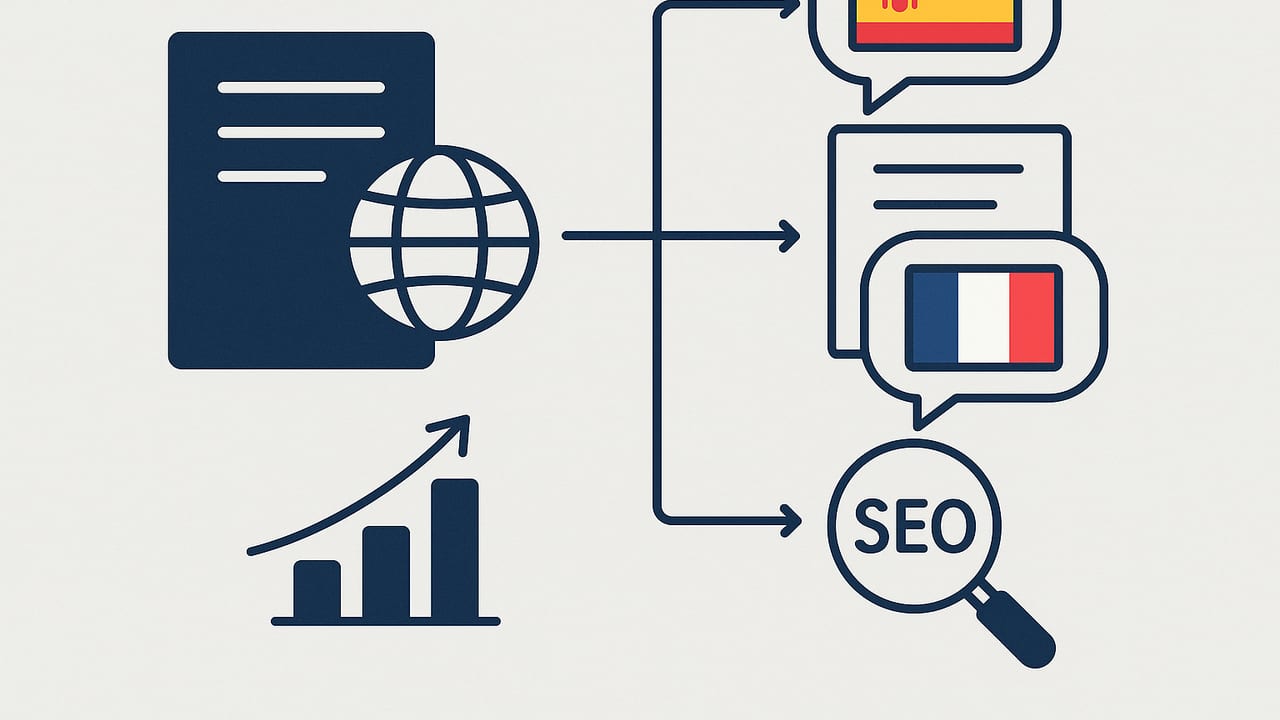
Choosing a multilingual content generator isn’t just about translating words; it’s about scaling high-quality, search-optimized content across markets without losing nuance, speed, or governance. This guide explains what to look for, how to evaluate tools, and how to build workflows that protect brand voice and win organic traffic in every locale.
What a Multilingual Content Generator Should Actually Do
Many teams equate multilingual publishing with translation. That’s a costly mistake. A strong multilingual content generator should handle end-to-end content operations, from research to on-page SEO and localization guardrails.
- Keyword localization, not translation: Targets the phrases real users search in each market.
- Market-aware tone and examples: Adjusts currency, units, cultural references, and regulations.
- Structural consistency: Replicates headings, schema, and internal link logic per locale.
- SEO governance: Enforces canonical, hreflang, and noindex rules to prevent duplication.
- Quality gates: Provides glossaries, style guides, and locale briefs to keep voice consistent.
- Scale & automation: Supports batching, scheduling, API access, and error reporting.
- Analytics feedback loop: Surfaces per-locale CTR, ranking, and indexation to guide improvements.
SEO Fundamentals You Can’t Compromise
International SEO success depends on a few non-negotiables. Ensure your generator and publishing stack support these from day one.
1) Hreflang and Canonicals
Use self-referencing canonical tags per page, and bidirectional hreflang annotations between equivalent pages across locales.
<link rel="canonical" href="https://example.com/en/product-x/" />
<link rel="alternate" hreflang="en" href="https://example.com/en/product-x/" />
<link rel="alternate" hreflang="es-mx" href="https://example.com/es-mx/producto-x/" />
<link rel="alternate" hreflang="fr" href="https://example.com/fr/produit-x/" />
<link rel="alternate" hreflang="x-default" href="https://example.com/" />
2) URL Strategy
Prefer separate, crawlable URLs per locale: subfolders (/es-mx/), subdomains (es.example.com), or country ccTLDs. Avoid query parameters for language unless unavoidable.
3) Consistent On-Page Elements
- Unique, localized title and meta description per locale.
- Localized structured data (e.g., Article, Product) with correct language tags.
- Local currency, units, dates, and address formats.
4) Performance and Crawlability
- Fast TTFB and LCP in each region (consider CDNs and edge caching).
- Static export or cache-first rendering for blog pages.
- Clean internal linking to help crawlers discover localized clusters.
Evaluation Framework: How to Choose a Multilingual Content Generator
Use the table below to compare vendors. Run a proof-of-concept on 10–20 URLs per locale before scaling.
| Criterion | Why It Matters | What to Test |
|---|---|---|
| Keyword Localization | Ranks for the phrases users actually search | Does it map English keywords to top local variants and intent? |
| Hreflang & Canonicals | Prevents duplication and cannibalization | Are tags correct, reciprocal, and validated by Search Console? |
| Quality Controls | Protects brand voice and accuracy | Glossary, tone rules, human-in-the-loop QA options |
| Content Structure | Improves readability and snippet eligibility | Consistent H1–H3, lists, tables, schema, internal links |
| Localization Depth | Boosts engagement and conversions | Currency, units, examples, legal/regulatory notes |
| Scale & Scheduling | Meets publishing cadence | Batching, queues, retries, daily/weekly cadence |
| Integrations | Saves time, reduces errors | API, webhooks, sitemap updates, analytics connectors |
| Analytics & Feedback | Continuous improvement | Per-locale CTR, rankings, indexation, content scoring |
| Governance | Risk and compliance | PII handling, safety filters, approval workflows |
Workflow Blueprint: From Research to Publish
- Market Discovery: Identify priority locales via demand, ease of entry, and SERP competitiveness. Build a locale brief for each market.
- Keyword & Topic Clustering: Localize seed terms, cluster by intent, and map to content types (how-to, comparisons, glossaries).
- Template & Schema Setup: Define headings, internal link slots, and schema (e.g., Article, FAQ) once; reuse across locales.
- Draft Generation: Generate localized drafts that follow the template. Enforce glossary and style rules programmatically.
- Localization QA: Human or AI-assisted review for tone, currency/units, and legal notes; spot-check named entities.
- On-Page SEO: Optimize titles, metas, image alts, and internal links to local hub pages. Add hreflang and canonical.
- Publish & Interlink: Deploy on locale-specific URLs; interlink related articles and pillar pages for each language.
- Monitor & Iterate: Check indexation, CTR, dwell time, and conversions. Improve content where CTR or dwell time lags.
Sample Locale Brief (Spanish — Mexico)
- Audience: SMB owners comparing content platforms
- Tone: Practical, concise, use neutral Spanish (MX)
- Search nuances: "posicionamiento web" often vs. "SEO"; "blog" accepted borrowing
- Units & currency: MXN, metric; examples in pesos
- Style rules: Avoid peninsular idioms; use tú/usted consistently
Prompt Pattern for Consistent Localization
System: You are a localization-savvy SEO writer.
User: Generate a 1,200-word article for {locale} on the topic {topic}.
- Include H1, H2, H3, lists, and a comparison table.
- Localize keyword set: {localized_keywords}
- Use currency {currency}, units {units}, and tone {tone}.
- Follow style guide: {style_rules}
- Insert internal links to {local_hubs} using localized anchors.
- Return HTML only, no commentary.
Technical Must-Haves: Hreflang and Sitemaps
Your publishing pipeline should automatically stitch hreflang pairs and update sitemaps. Here’s an example of an XML sitemap entry with xhtml:link alternates:
<url>
  <loc>https://example.com/en/guide/</loc>
  <xhtml:link rel="alternate" hreflang="en" href="https://example.com/en/guide/" />
  <xhtml:link rel="alternate" hreflang="es-mx" href="https://example.com/es-mx/guia/" />
  <xhtml:link rel="alternate" hreflang="fr" href="https://example.com/fr/guide/" />
  <lastmod>2024-12-10</lastmod>
  <changefreq>weekly</changefreq>
  <priority>0.8</priority>
</url>
Validate hreflang using Search Console’s International Targeting report and server logs. Watch for non-reciprocal pairs, wrong language-region codes, and canonical misalignment.
Metrics That Matter (Per Locale)
- Indexation rate: Indexed URLs / submitted URLs. Low rates signal duplication, thin content, or crawl issues.
- Top-10 keyword coverage: Number of terms in the top 10; segment by search intent.
- CTR by query cluster: Low CTR with good position means titles/metas aren’t resonating locally.
- Dwell time & bounce: Check if content truly matches intent and cultural expectations.
- Internal link flow: Measure clicks and crawl paths to localized hub pages.
- Revenue/conversion: Track goal completions per locale to justify further expansion.
- Page performance: LCP/CLS by region; poor web vitals depress rankings and engagement.
Common Pitfalls and How to Prevent Them
| Pitfall | Symptom | Prevention/Fix |
|---|---|---|
| Machine-like translation | High bounce, low dwell | Locale briefs, tone rules, example rewrites for top pages |
| Incorrect hreflang pairs | Duplicate pages indexed, cannibalization | Automated reciprocal mapping + validation job |
| Mixed-language pages | Spanish page with English CTAs | Component-level localization and QA checks |
| Thin or duplicated content | Excluded by Google or low rankings | Unique intros, examples, FAQs, and local data per market |
| Wrong currency/units | Conversion drop-offs | Locale-aware formatting; test checkout or CTA flows |
| Slow pages in target regions | Poor web vitals | CDN, image compression, pre-rendering, regional edges |
Testing Plan: Prove It Before You Scale
- Select 3–5 locales and 10–20 URLs per locale.
- Define success metrics: indexation >90%, CTR +2–4 pts, top-10 coverage +20% in 8–12 weeks.
- Run A/B title tests on localized SERP snippets to lift CTR.
- QA pass on 20% of content: tone, entities, units, links.
- Instrument analytics by locale: query reports, SERP features, conversion goals.
- Iterate briefs, prompts, and internal links based on early data.
Governance: Keep Quality High as You Scale
- Glossary & style guide: Lock down brand terms, product names, and prohibited phrases per locale.
- Content roles: Define who approves templates, who reviews flagship posts, and SLAs for fixes.
- Safety filters: Prevent risky outputs (sensitive topics, medical/legal claims) where not allowed.
- Versioning & rollback: Keep snapshots of each localized page; ship safe defaults if checks fail.
Decision Checklist
- Supports 50–150+ locales with consistent quality
- Built-in keyword localization and clustering
- Automatic hreflang, canonicals, and sitemaps
- Template-driven HTML with schema and internal links
- Locale briefs, glossary enforcement, and QA workflows
- Batch scheduling, API, and analytics feedback loop
- Clear SLAs on performance and reliability
Rule of thumb: If a vendor cannot demonstrate correct hreflang across 20 test URLs in two languages and surface per-locale CTR within your analytics, they are not ready for scale.
Example: Internal Linking Pattern for Localized Clusters
For each market, create a pillar page and 6–10 spokes. Spokes link to the pillar with a localized anchor, and cross-link to 2–3 related spokes.
- Pillar: "Guía de SEO para PYMES"
- Spokes: "Cómo elegir palabras clave", "Estructura de contenidos", "Medición de resultados"
Replicate the same graph in French, German, etc., but ensure anchors are locally meaningful (not literal translations).
Putting It All Together
The right multilingual content generator will help you consistently produce localized, SEO-ready articles that respect culture, search behavior, and technical best practices—without multiplying headcount. Evaluate tools with a structured proof-of-concept, enforce governance with briefs and glossaries, and wire analytics into your publishing loop so every locale improves month over month.
If you prefer a fully hosted, hands-free approach to multilingual blogging and daily publishing, platforms like the24blog can help streamline the entire pipeline from research to scheduled posts.