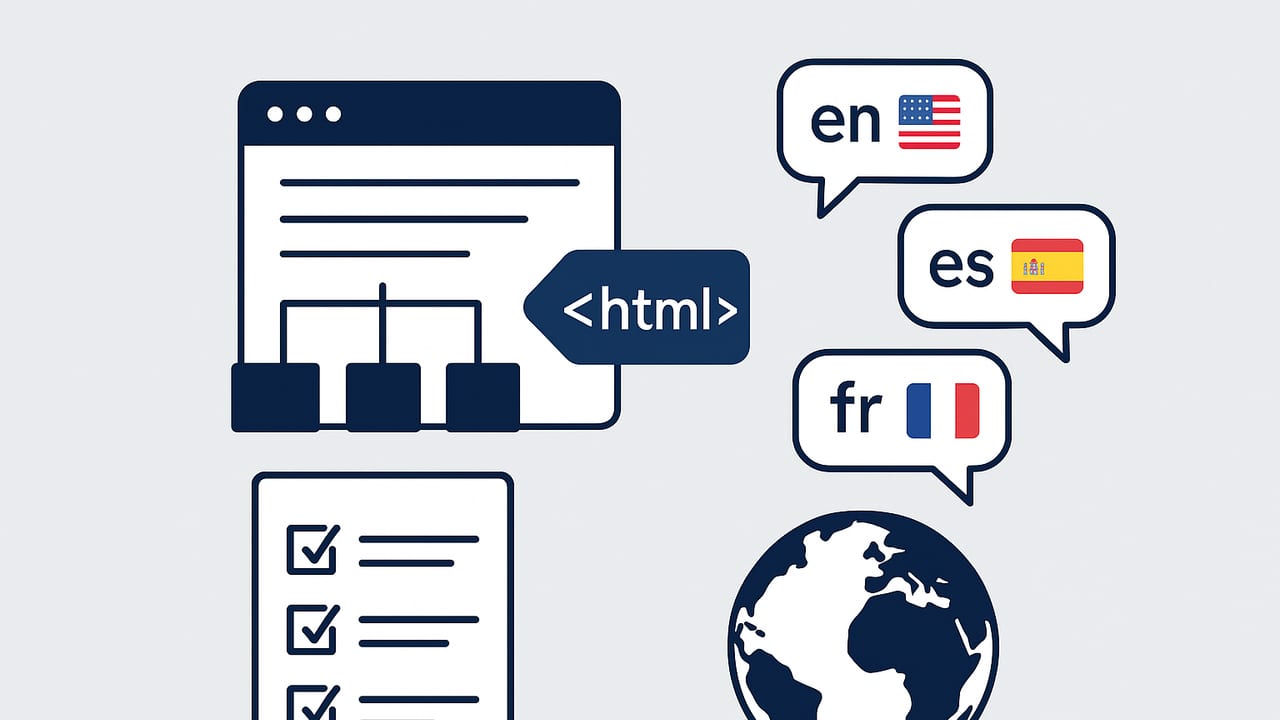
Expanding into multiple languages can unlock new markets, but it also introduces technical, editorial, and operational complexity. A high-performing multilingual site aligns information architecture, localization, and search signals so users reach the right language and country version with the least friction. This blueprint walks through the core decisions, technical patterns, and workflow safeguards that make multilingual SEO reliable at scale.
Plan Your Multilingual Architecture
Your site structure determines crawl efficiency, ranking signals, and maintenance overhead. Choose a model that matches your resources and international strategy.
| Structure | Pros | Cons | Recommended for |
|---|---|---|---|
| Subdirectories (example.com/fr/) | Consolidates domain authority; simple to manage and track; fast to launch. | Harder to geo-target by country; server/location signals less explicit. | Most multilingual sites seeking SEO efficiency and centralized governance. |
| Subdomains (fr.example.com) | Flexible hosting; geo-target per subdomain; clearer separation of content. | Authority split vs. folders; more DNS and property management. | When teams or vendors manage locales separately; edge hosting needs. |
| ccTLDs (example.fr) | Strong country signal; trust and CTR uplift in some markets. | Costly to maintain; authority fragmentation; legal/compliance per country. | Large brands with country-level operations and resources. |
URL and Locale Conventions
- Use ISO language-country codes when targeting a country variant (e.g.,
fr-fr,en-gb,pt-br). Language-only (fr) is fine for global language versions. - Keep slugs localized and keyword-informed (e.g.,
/es/aspiradoras-sin-bolsa/vs. literal translations). Avoid mixing languages in a single URL. - Set the HTML
langattribute per page (e.g.,<html lang="es-ES">) and usedir="rtl"for right-to-left languages.
Hreflang, Canonicals, and Sitemaps
Hreflang prevents cross-locale duplication and routes users to the best language/country version. It must be complete, reciprocal, and consistent with canonicals.
HTML Head Example
<link rel="canonical" href="https://example.com/en/product/" />
<link rel="alternate" href="https://example.com/en/product/" hreflang="en" />
<link rel="alternate" href="https://example.com/en-gb/product/" hreflang="en-GB" />
<link rel="alternate" href="https://example.com/fr/produit/" hreflang="fr" />
<link rel="alternate" href="https://example.com/fr-fr/produit/" hreflang="fr-FR" />
<link rel="alternate" href="https://example.com/es/producto/" hreflang="es" />
<link rel="alternate" href="https://example.com/" hreflang="x-default" />
XML Sitemap with Hreflang
<urlset xmlns="http://www.sitemaps.org/schemas/sitemap/0.9"
        xmlns:xhtml="http://www.w3.org/1999/xhtml">
  <url>
    <loc>https://example.com/en/product/</loc>
    <xhtml:link rel="alternate" hreflang="en"    href="https://example.com/en/product/" />
    <xhtml:link rel="alternate" hreflang="en-GB" href="https://example.com/en-gb/product/" />
    <xhtml:link rel="alternate" hreflang="fr"    href="https://example.com/fr/produit/" />
    <xhtml:link rel="alternate" hreflang="es"    href="https://example.com/es/producto/" />
    <xhtml:link rel="alternate" hreflang="x-default" href="https://example.com/" />
  </url>
</urlset>
Common Hreflang Pitfalls
- Missing reciprocals: If
enpoints tofr, thefrpage must point back. - Conflicting canonicals: Each locale must canonicalize to itself, not to the primary language.
- Incorrect codes: Use
en-GB(noten-UK),zh-Hans/zh-Hantfor scripts when relevant. - Forgetting x-default: Add for language selectors, global pages, or automatic geo/language detection hubs.
Localization Beyond Translation
A high-quality multilingual experience adapts content to the market: vocabulary, measurements, compliance, and cultural relevance. This improves engagement and conversion—signals that also help SEO.
| Element | Localize How | Notes |
|---|---|---|
| Product names | Use local terms (e.g., ordenador ES vs. computadora LATAM) | Check search volume per locale before standardizing. |
| Units & currency | Metric vs. imperial; local currency symbols and formatting | Show localized prices server-side; avoid flashing USD first. |
| Dates & punctuation | DD/MM/YYYY vs. MM/DD/YYYY; decimal comma vs. point | Respect locale formatting in rich snippets too. |
| Compliance | Cookie banners, data residency, age gating, disclosures | Laws vary by country; coordinate with legal. |
| Imagery & examples | Local holidays, payment methods, shipping expectations | Update screenshots and UI labels in images. |
Multilingual Keyword Research and Intent
Don’t translate keywords—research them per market. Language and culture shape how users search, which SERP features appear, and which competitors rank.
- Start with seed pages and extract terms from local competitors ranking on page 1.
- Map queries to intent (informational, commercial, transactional) per locale.
- Vet terms in native context: spelling, colloquialisms, synonyms, and regional variants.
- Localize titles and meta descriptions for click-through, not just translation.
| Concept | Locale | High-Intent Variant | Notes |
|---|---|---|---|
| Vacuum cleaner | UK (en-GB) | hoover cordless | Brand genericization impacts volume and modifiers. |
| Cell phone | US vs. UK | cell phone plans (US) / mobile phone deals (UK) | Ad copy and CTAs should match local speech. |
| Computer | ES vs. MX | ordenador portátil (ES) / computadora portátil (MX) | Avoid mixing in one page; split locales if needed. |
On-Page SEO for Multilingual Pages
- Title/H1: Localize for intent and readability; place main keyword early; avoid direct translation if unnatural.
- Meta description: Use market-specific value props and currencies; test CTR by locale.
- Internal links: Use localized anchor text; connect related articles within the same language and provide a subtle link to the equivalent page in other languages.
- Images: Localize alt text and captions; consider separate images when text is baked into graphics.
- Breadcrumbs: Localize labels; maintain consistent hierarchy across locales.
- Structured data: Set
inLanguageand local specifics (priceCurrency, availability).
Structured Data Example
{
  "@context": "https://schema.org",
  "@type": "Article",
  "headline": "Guía de aspiradoras sin bolsa",
  "inLanguage": "es-ES",
  "author": {"@type": "Person", "name": "Equipo de Contenido"},
  "datePublished": "2024-06-15",
  "mainEntityOfPage": "https://example.com/es/aspiradoras-sin-bolsa/"
}
Performance, UX, and Accessibility
- Fonts: Preload and subset fonts for scripts (Latin, Cyrillic, Arabic). Avoid layout shifts with
font-display: swapand appropriate fallbacks. - Right-to-left (RTL): Apply
dir="rtl"on thehtmlelement for Arabic/Hebrew; flip icons and carousel controls; test focus order. - Language switching: Make the language selector accessible (
<nav aria-label="Language">), persist user choice, and avoid SEO traps (don’t index the selector page). - Auto-redirects: If using IP/browser detection, offer a visible opt-out and avoid redirecting search crawlers; serve a banner suggestion instead of hard redirect where possible.
- Core Web Vitals: Optimize per locale; some markets have slower networks—use adaptive image formats and CDNs close to users.
Governance, Workflow, and QA
- Terminology and style: Maintain a glossary and style guide per language; lock brand terms.
- Translation memory: Reuse approved phrases; reduce inconsistency and cost.
- Review tiers: High-impact pages: human translation + in-market review. Lower tiers: MT + light edit with automated QA.
- Automation: Validate hreflang reciprocity, canonical alignment, and missing alt/aria labels before publishing.
- Content parity: Track source updates; flag locales when originals change to prevent drift.
Analytics and Measurement
- Search Console: Create properties for each domain/subdomain or subfolder (via domain or URL prefix) to monitor indexing and hreflang issues per locale.
- GA4: Group content by locale; build reports by
page_path + query stringor custom dimension for language code. - KPI stack: Organic sessions, indexed pages, CTR by language, conversions and AOV by locale, and Core Web Vitals distribution per market.
- Rank tracking: Use localized SERPs and language preferences; track competitors specific to each market.
Quick Multilingual SEO Checklist
- Architecture decided (folders, subdomains, or ccTLDs) and consistent across locales.
- Localized slugs, titles, H1s, and meta with market-intent keywords.
- Correct
langattribute and RTL support where needed. - Hreflang implemented with reciprocals; self-referencing canonicals;
x-defaultset appropriately. - Localized structured data including
inLanguageand currency. - Language selector crawl-safe and accessible; no forced geo-redirects for bots.
- Images, alt text, and media localized; units, currency, and formats adapted.
- Automated QA for broken links, hreflang mismatches, and parity with source content.
- Separate Search Console coverage per locale; KPIs monitored monthly.
Common Pitfalls and How to Fix Them
- Indexing the language hub: Ensure the language selector page uses
noindexif it has near-duplicate content and exists only to route users. - Mixed-language pages: Avoid combining multiple languages on one page; use clear locale boundaries for SEO and UX.
- Duplicate content across locales: If content is identical (e.g., en-US and en-GB), still separate URLs with proper hreflang to steer users correctly.
- Thin or machine-only translations: Prioritize your top pages for human review; low-quality translations harm engagement and rankings.
- Forgetting internal link localization: Link modules often stay in the source language; ensure anchors and destinations are locale-specific.
- Canonical to the wrong version: Each localized page should canonicalize to itself, not to the original language, unless it’s a deliberate duplicate with no index intent.
Implementation Notes and Patterns
When rolling out multilingual sections, test on a small set of URLs, validate technical signals, and then scale.
Minimal Head Snippet
<head>
  <meta charset="utf-8" />
  <meta name="viewport" content="width=device-width, initial-scale=1" />
  <title>Aspiradoras sin bolsa: guía y comparativas</title>
  <meta name="description" content="Compara las mejores aspiradoras sin bolsa con análisis de rendimiento y precio." />
  <link rel="canonical" href="https://example.com/es/aspiradoras-sin-bolsa/" />
  <link rel="alternate" hreflang="es" href="https://example.com/es/aspiradoras-sin-bolsa/" />
  <link rel="alternate" hreflang="en" href="https://example.com/en/bagless-vacuum-cleaners/" />
  <link rel="alternate" hreflang="x-default" href="https://example.com/" />
</head>
Language-Safe Routing
Prefer suggestion banners over automatic redirects. If you must redirect, whitelist crawler user agents and always let users switch manually.
Best practice: detect browser language, show a non-intrusive banner, and remember the user’s preference via a first-party cookie. Don’t block the source language page from being crawled.
Roadmap for Scaling Multilingual Content
- Pilot: Launch 1–2 locales on a well-structured folder/subdomain, implement hreflang and tracking, and measure Core Web Vitals and CTR shifts.
- Prioritize: Rank markets by TAM, CPCs, competition, and localization lift. Tackle pages with highest revenue contribution first.
- Templatize: Build reusable page templates with locale tokens for dates, units, and currencies.
- Automate QA: Integrate checks in CI/CD to catch hreflang reciprocity errors, missing
langtags, and orphaned pages. - Optimize: A/B test localized titles/metas and compare engagement vs. direct translations; roll out winners market-wide.
Executing multilingual SEO well is less about one-off translations and more about systemizing architecture, governance, and continuous improvement. With a clear structure, robust hreflang, and market-aware content, your global pages can earn visibility and trust faster—and stay resilient as you scale into new languages and countries.
Note: If you prefer a hosted, automated workflow for research, localization, and daily publishing across 150+ languages, platforms like the24blog provide a hands-free way to run a multilingual content program without WordPress maintenance overhead.