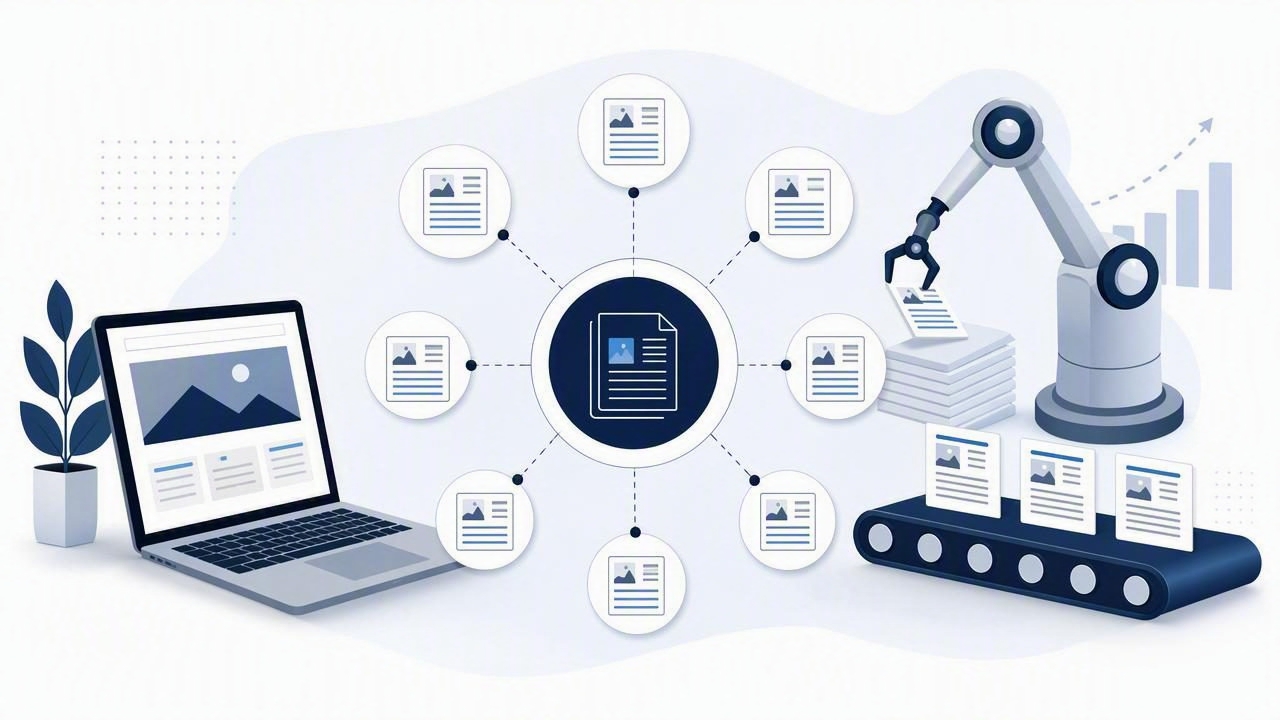
WordPress has long been the default answer for business blogging. It is flexible, widely supported, and familiar to many marketers. However, flexibility can also create friction. Hosting updates, plugins, security patches, theme conflicts, editorial handoffs, and manual publishing can take valuable time away from the work that actually drives organic growth: building useful content around the topics your audience searches for.
Today, it is possible to run a blog without WordPress with content cluster automation. Instead of assembling a blog from separate tools and managing every publishing task by hand, businesses can use a hosted blogging workflow that connects keyword research, content planning, creation, optimization, and publishing.
This approach is not about producing more pages for the sake of volume. It is about creating an organized, sustainable SEO system that helps search engines and readers understand your expertise. Here is how it works, what to plan before you begin, and how to maintain quality as your content library grows.
Why Businesses Look Beyond WordPress
WordPress remains useful for many organizations, especially those needing deep design customization or complex ecommerce functionality. But a standard WordPress blog often requires ongoing technical attention. Even a relatively simple setup can involve selecting hosting, installing themes, configuring plugins, improving page speed, setting up backups, and resolving compatibility issues.
For a lean marketing team, the operational burden can outweigh the benefits. A business that only needs an SEO-focused blog may prefer a system where the infrastructure is handled in the background.
- Less maintenance: No plugin updates, database repairs, or theme troubleshooting.
- Faster publishing: Articles can move from approved topic to live page through a repeatable workflow.
- Cleaner focus: Teams spend more time on audience needs, expertise, and conversion paths.
- Better scalability: A structured process makes it easier to expand into new topics and languages.
- Fewer handoffs: Planning, writing, SEO checks, and publishing can operate in one coordinated system.
The goal is not to avoid editorial responsibility. It is to remove avoidable technical work so content strategy receives the attention it deserves.
What Is Content Cluster Automation?
A content cluster is a group of related pages organized around a broad subject. Usually, one comprehensive pillar page covers the central topic, while supporting articles explore narrower questions, comparisons, use cases, and problems. Internal links connect these pages in a way that is useful to readers and understandable to search engines.
For example, a SaaS company serving finance teams might build a cluster around “expense management.” Its pillar article could explain the complete process, while supporting posts address receipt tracking, expense policy templates, reimbursement workflows, and software comparisons.
Content cluster automation uses systems and rules to make this model easier to execute consistently. Automation may assist with finding keyword patterns, grouping related searches, assigning article formats, generating first drafts, creating metadata, scheduling publication, and checking internal linking opportunities.
| Workflow Stage | Manual Blogging Approach | Automated Cluster Approach |
|---|---|---|
| Topic research | Occasional spreadsheet research | Ongoing keyword discovery and topic grouping |
| Content planning | Standalone article ideas | Pillars and supporting pages mapped by search intent |
| Production | Each draft starts from zero | Repeatable briefs, templates, and editorial standards |
| Publishing | Manual formatting and scheduling | Scheduled, consistent publishing workflows |
| Optimization | Irregular updates | Periodic performance reviews and content refreshes |
Automation supports consistency, but it should not eliminate judgment. The best systems make room for human review, original insights, accurate claims, and a clear brand voice.
Build the Foundation Before You Publish
A blog without WordPress still needs a strong strategic foundation. Before producing articles, define who you want to reach, what problems they need to solve, and what business goals content should support.
1. Define audience segments and search intent
Start with a small number of meaningful audience groups. A cybersecurity provider, for instance, may target IT managers, compliance leaders, and small-business owners. These groups may search for similar terms, but their questions and desired outcomes differ.
Then classify keywords by intent:
- Informational: “what is endpoint security”
- Commercial investigation: “best endpoint security tools”
- Transactional: “endpoint security pricing”
- Problem-solving: “how to prevent ransomware attacks”
A healthy cluster contains several intent types. Informational articles build topical relevance and early-stage trust, while comparison and solution-focused pages can support buying decisions.
2. Choose pillar topics with business relevance
A pillar should be broad enough to support multiple related articles but focused enough to match your expertise. Avoid creating clusters around broad, high-volume keywords that have little connection to your offer. Traffic that never becomes an audience is rarely a useful metric.
Evaluate a potential pillar according to four factors:
- Is the subject relevant to your customers?
- Can your business add credible, useful insight?
- Does the topic contain multiple supporting questions?
- Is there a logical next step for the reader?
3. Map supporting articles before drafting
Planning a cluster upfront prevents duplicate content and reveals gaps in your coverage. A simple map may include a pillar guide, beginner questions, implementation guides, alternatives, mistakes, templates, and industry-specific applications.
Pillar: Remote employee onboarding
├── Remote onboarding checklist
├── How to onboard international employees
├── Common remote onboarding mistakes
├── Remote onboarding software comparison
├── 30-60-90 day onboarding plan template
└── How to measure onboarding success
This structure gives each page a distinct purpose while making internal links natural rather than forced.
Set Up an Automated Editorial Workflow
Once your cluster map is ready, create a workflow that turns strategy into steady publishing. The exact tools will vary, but the process should be documented and repeatable.
Keyword research and prioritization
Automated keyword research can surface long-tail phrases, related questions, and emerging themes more efficiently than one-off brainstorming. Still, every keyword should be evaluated in context. Search volume alone does not tell you whether a phrase is valuable, achievable, or aligned with your audience.
Create a prioritization score using factors such as search intent fit, topical relevance, competition, conversion potential, and cluster importance. This helps prevent the editorial calendar from becoming a random list of high-volume terms.
Content briefs and quality standards
Each article should begin with a brief, even if AI helps create the draft. A reliable brief includes the primary query, reader intent, key subtopics, internal links, recommended examples, desired call to action, and factual sources to verify.
Automation can accelerate the process, but a brief keeps every article connected to a strategic reason for existing.
Set editorial standards for accuracy, readability, tone, originality, and formatting. For sensitive industries such as healthcare, legal services, or finance, qualified human review is especially important before publication.
Publishing and technical SEO checks
A hosted blog platform should make publishing straightforward, but basic SEO quality checks still matter. Before an article goes live, confirm that it has a descriptive title, clear heading hierarchy, readable URL, compelling meta description, relevant internal links, and appropriate image alternative text.
- Use one clear H1 that matches the article’s primary topic.
- Organize sections with logical H2 and H3 headings.
- Link to related cluster pages where the connection helps readers.
- Avoid thin, repetitive, or unverified AI-generated text.
- Make sure pages load quickly and work well on mobile devices.
Use Internal Linking to Strengthen Every Cluster
Internal links are the connective tissue of a content cluster. They help users discover the next useful resource and help search engines understand how pages relate to one another. Every supporting article should link back to its pillar page when relevant, and pillar pages should point readers toward deeper supporting resources.
Use descriptive anchor text rather than generic phrases such as “click here.” For example, an article about hiring workflows could link to a related guide with the anchor text remote onboarding checklist. The link should appear where it genuinely adds value, not as a repeated footer list on every page.
As the blog grows, periodically audit internal links. New articles may create opportunities to strengthen older pages, while outdated links or orphaned pages can weaken the reader experience.
Expand Globally Without Duplicating Weak Content
Multilingual blogging can substantially expand organic reach, but translation should not be treated as a simple copy-and-paste exercise. Search behavior differs by language and market. A keyword that performs well in one country may be rarely used, overly broad, or culturally inappropriate elsewhere.
For each target language, localize keyword research, examples, terminology, currencies, and calls to action. Consider whether a topic is relevant in that market before translating it. Quality matters more than publishing the same number of pages in every language.
Automation can help coordinate multilingual content production, but native-level review remains valuable for brand-sensitive copy, technical terminology, and culturally nuanced advice.
Measure the Metrics That Improve Your Content System
Content clusters compound over time, so evaluate them as connected systems rather than isolated posts. Track organic impressions, clicks, rankings, engagement, conversions, and assisted conversions. Also review which articles bring users into the cluster and which ones move readers toward high-value pages.
When a page underperforms, do not immediately publish a replacement. First, diagnose the cause. It may need a stronger match to search intent, clearer structure, more original examples, better internal links, fresher information, or more useful supporting content.
A quarterly review cycle is usually enough for most teams. Refresh successful articles when information changes, consolidate pages that compete for the same query, and add supporting content where search demand reveals a gap.
Conclusion: Make Blogging a System, Not a Technical Chore
Choosing to run a blog without WordPress does not mean lowering your standards or giving up control. It means selecting a workflow that prioritizes consistent SEO execution over routine platform maintenance. With thoughtful cluster planning, reliable quality checks, purposeful internal linking, and measured automation, a blog can become a durable source of relevant organic traffic.
Businesses that want a fully hosted approach can explore platforms such as the24blog, which combine AI-assisted content workflows with multilingual publishing and SEO-focused automation. Whatever platform you choose, the lasting advantage comes from publishing genuinely helpful content in a structure that makes sense for your audience.