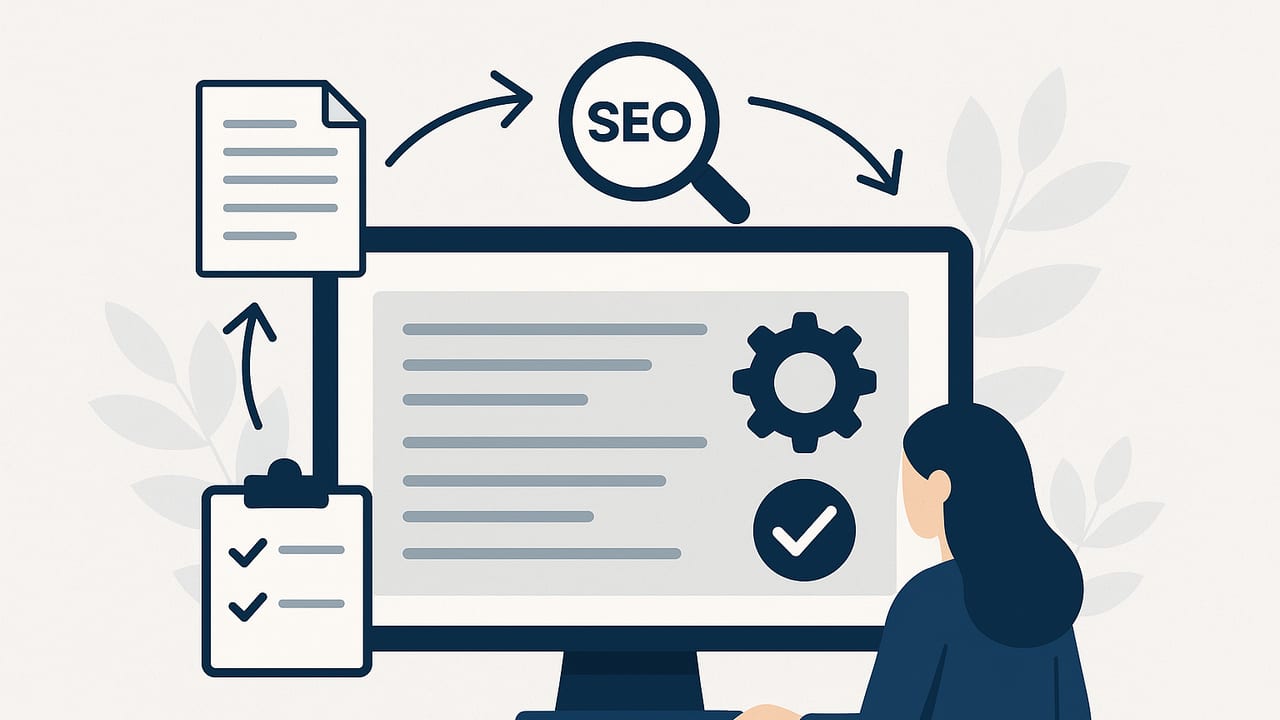
SEO content automation promises consistent growth without ballooning costs, yet many teams rush in and end up automating the wrong things: ideas without intent, drafts without guardrails, and publishing without measurement. This guide shows you how to build a pragmatic, high‑quality seo content automation program that scales output while protecting brand trust, rankings, and conversions.
What Is SEO Content Automation?
SEO content automation is the use of software, AI models, and scripted workflows to research, plan, create, optimize, publish, and measure search content with minimal manual effort. It does not mean removing humans from the loop; it means reserving human judgment for where it matters—strategy, editorial decisions, and subject‑matter accuracy—while automating repetitive steps.
The best systems automate predictable tasks (data collection, clustering, templated on‑page optimization) and orchestrate human review for judgment calls (topic selection, claims verification, brand voice). Think of it as industrialized content operations aligned to search intent.
A Repeatable Framework for SEO Content Automation
Use a pipeline that converts raw keyword data into optimized, compliant articles. A simple yet robust framework looks like this:
- Discover: Pull keywords, questions, and entities from sources like Search Console, keyword tools, and internal search. Cluster by intent and commercial value.
- Prioritize: Score opportunities by estimated traffic, difficulty, topical relevance, and conversion potential. Build a backlog with rationales.
- Brief: Auto‑generate content briefs containing target queries, entities, outline, SERP notes, internal links, and required citations. Humans review and approve.
- Draft: Use AI to produce first drafts that follow the brief and on‑page requirements. Include placeholders for expert quotes and proprietary data.
- Optimize: Automatically check headings, meta tags, schema, internal links, and entity coverage. Flag issues, never blindly fix.
- Review: Human editors verify facts, tone, and originality; SMEs approve claims. Run final QA checks (readability, accessibility).
- Publish: Schedule posts, submit sitemaps, and trigger indexing pings. Version content and log changes for audits.
- Measure: Track rankings, clicks, CTR, engagement, conversions, and content health. Feed learnings back into the backlog.
Data Sources and APIs to Power Your Pipeline
- Keyword and SERP data: Search Console API, Google Trends, Ahrefs/Semrush exports.
- Entity extraction: NLP libraries (spaCy), Google Natural Language API, OpenAI function calling.
- CMS and publishing: Headless CMS APIs, static site CI/CD, or hosted platforms.
- Analytics: GA4, Search Console, rank trackers, and conversion events from your CDP/CRM.
Prompt Patterns That Scale
Great automation relies on consistent prompts grounded in data. Use structured prompts that reference the brief and constrain outputs. Here’s a simple pattern:
{
  "role": "You are an SEO editor.",
  "goal": "Draft a human‑sounding article that satisfies search intent.",
  "constraints": {
    "word_count": 1350,
    "tone": "expert yet practical",
    "avoid": ["bold claims without sources", "thin definitions"],
    "links": {
      "internal": ["/category/automation", "/guide/schema-markup"],
      "external": ["https://schema.org/Article"]
    }
  },
  "inputs": {
    "primary_query": "seo content automation",
    "supporting_queries": ["ai content workflow", "content brief template"],
    "entities": ["E-E-A-T", "schema markup", "hreflang"],
    "outline": ["Definition", "Framework", "Quality gates", "Metrics"]
  },
  "output": {
    "format": "HTML",
    "sections": ["Intro", "Main sections with h2/h3", "Conclusion"]
  }
}
Keep prompts modular. Small changes to one component (e.g., tone or internal links) shouldn’t require rewriting the entire prompt.
Automate tasks, not judgment. Machines move fast; editors keep you honest.
Quality Safeguards: Protecting Trust at Scale
Quality is non‑negotiable. Build safeguards into each stage:
- E‑E‑A‑T alignment: Attribute expertise by citing credentials, linking to author bios, and referencing primary sources.
- Fact‑checking: Require source URLs for statistics. Reject unverifiable claims. Prefer primary research.
- Originality: Run plagiarism checks and ensure unique angles or data (e.g., mini case studies, internal benchmarks).
- Readability and accessibility: Enforce sentence length, descriptive alt text, and keyboard‑friendly headings.
- Brand voice: Maintain a style guide and include examples in prompts. Use a voice linter to flag off‑brand phrasing.
Human‑in‑the‑Loop Gates
- Brief approval: Editor verifies intent, outline, and sources before drafting.
- SME pass: Subject experts validate accuracy and add nuance.
- Final editorial QA: Check meta tags, schema, links, and compliance before publish.
Automated On‑Page Checks
- Heading structure: H1 exactly once; H2/H3 hierarchical.
- Meta tags: Title length ~55–65 characters; description ~120–150 characters.
- Entity coverage: Ensure target entities appear naturally; avoid keyword stuffing.
- Internal links: Minimum 2–4 relevant links including one to a pillar page.
- Schema presence: Article, FAQ, How‑To, or Product as applicable.
Manual vs Automated vs Hybrid: What Actually Wins?
| Approach | Speed | Cost | Quality Control | Scalability |
|---|---|---|---|---|
| Manual | Slow | High | High (if editorial capacity exists) | Limited by headcount |
| Automated | Fast | Low–Medium | Risky without safeguards | High |
| Hybrid (Recommended) | Fast enough | Optimized | High with human gates | High and sustainable |
Entity SEO and Structured Data in Automation
Modern search favors entities and context. Bake entity coverage and schema generation into your pipeline. Ensure your system knows which entities matter for the topic and verifies they’re used naturally in the draft and headings.
Add structured data automatically. Here’s a minimal Article JSON‑LD you can templatize:
<script type="application/ld+json">
{
  "@context": "https://schema.org",
  "@type": "Article",
  "headline": "SEO Content Automation: Frameworks, Prompts, and Safeguards",
  "author": {"@type": "Person", "name": "Your Editor"},
  "datePublished": "2025-01-01",
  "image": ["https://example.com/cover.jpg"],
  "mainEntityOfPage": {"@type": "WebPage", "@id": "https://example.com/seo-content-automation"},
  "about": ["SEO", "Content Automation", "Entities"]
}
</script>
Extend with FAQPage or HowTo when appropriate, but avoid spammy or irrelevant schema.
Metrics That Matter
Automation without measurement is guesswork. Track leading and lagging indicators and wire them into dashboards and alerts.
- Leading indicators: Indexation rate, time to first crawl, SERP coverage, and early impressions.
- Core SEO metrics: Clicks, CTR, average position by query cluster, and rich result adoption.
- Engagement and UX: Scroll depth, time on page, and return visitor rates.
- Business impact: Assisted conversions, demo requests, revenue influenced.
- Operational health: Draft‑to‑publish cycle time, QA failure rates, rework percentage.
Common Pitfalls (and How to Avoid Them)
- Thin content at scale: Fix by enforcing briefs with clear intent, examples, and mandatory sections.
- Hallucinated facts: Force citation extraction and block publish if sources are missing.
- Keyword stuffing: Optimize for entities and topics, not just exact matches. Use semantic variants.
- Orphaned pages: Auto‑suggest internal links from related clusters before publish.
- Duplicated angles: De‑duplicate via similarity checks against your corpus.
- Neglecting updates: Schedule refresh cycles based on decay and intent shifts.
A Sample Weekly Automation Cadence
- Monday: Pull Search Console deltas; refresh keyword clusters.
- Tuesday: Generate and approve briefs for top 5 opportunities.
- Wednesday: Draft articles; SMEs add quotes and data.
- Thursday: Optimization, schema, and internal linking checks.
- Friday: Publish, submit sitemaps, and annotate analytics.
Multilingual SEO Content Automation
Translating content expands reach—but literal translation often misfires. Automate with safeguards:
- Intent alignment: Re‑evaluate queries per locale; don’t reuse English clusters blindly.
- Transcreation over translation: Allow tone, examples, and CTAs to adapt culturally.
- Technical SEO: Generate correct
hreflangpairs, localized slugs, and language‑specific sitemaps. - Local sources: Prefer regional data and citations for credibility.
Getting Started: A 30‑Day Plan
- Week 1: Define goals, KPIs, and guardrails. Select tools, connect data sources, and draft your style guide.
- Week 2: Build the brief generator and on‑page checkers. Create prompt templates and test on one topic cluster.
- Week 3: Run a pilot: 5 articles from discovery to publish. Instrument dashboards and collect feedback.
- Week 4: Refine prompts, tighten QA, add schema automation, and plan a steady cadence (e.g., 3–10 posts/week).
Tools and Build vs Buy Considerations
Before building everything from scratch, weigh costs and complexity. You can stitch together a stack from keyword tools, LLM APIs, headless CMSs, and CI/CD—or choose a hosted system that handles research, generation, and publishing with built‑in QA. For teams that want a hands‑off option, a platform like the24blog can provide automated keyword research, multilingual generation, and scheduled publishing in one place.
Key Takeaways
- Automate repeatable tasks; keep humans for strategy, accuracy, and voice.
- Design a clear pipeline: discover → prioritize → brief → draft → optimize → review → publish → measure.
- Guard quality with E‑E‑A‑T signals, citations, originality checks, and schema.
- Measure both outcomes (traffic, conversions) and operations (QA failures, cycle time).
- For multilingual growth, prioritize transcreation and technical correctness with
hreflang.
Done right, seo content automation compounds: every process improvement scales across the entire library, letting you grow faster without sacrificing trust.