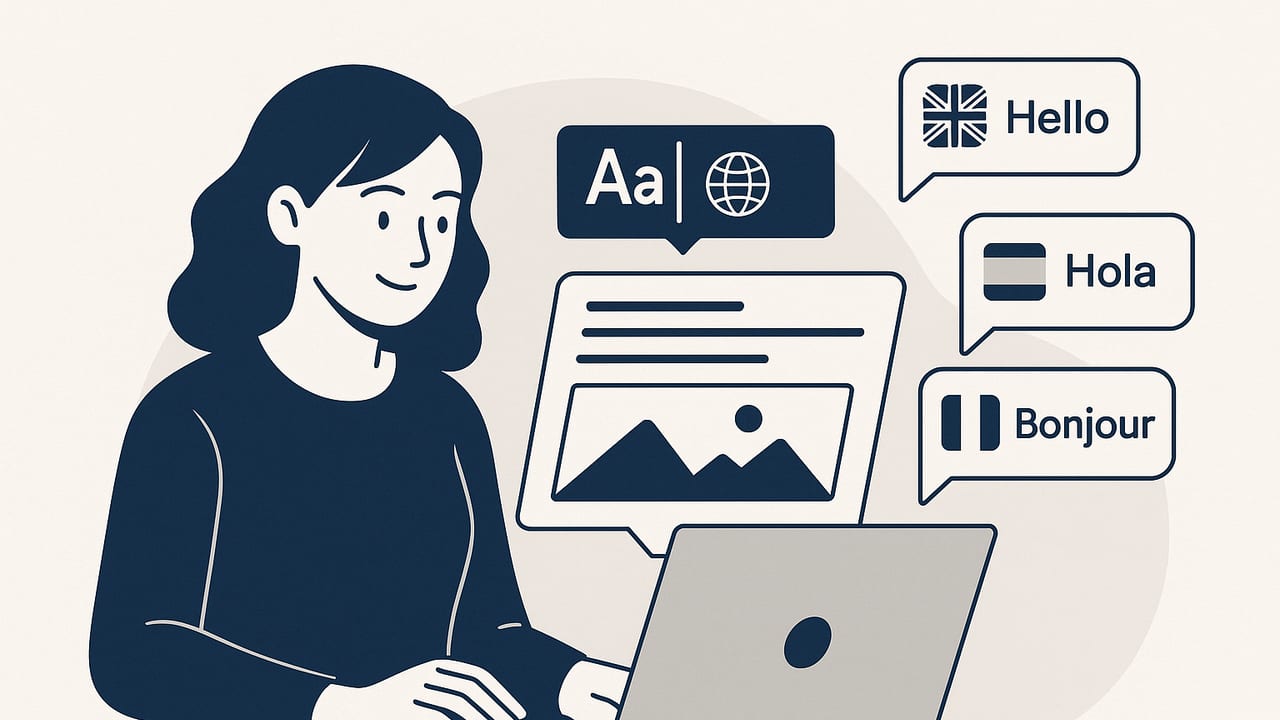
Publishing in multiple languages can turn a single trip into a global audience magnet—but the translation and localization workload is real. A smart travel bloggers multilingual blog post generator workflow helps you scale content in dozens of languages, keep on-page SEO tight, and stay authentic to your voice. This guide shows you how to design that system: strategy, tools, safeguards, and repeatable templates you can use on your very next trip.
What Is a Multilingual Blog Post Generator?
A multilingual blog post generator is an AI-powered workflow that takes your source material—trip notes, photos, voice memos, map pins, or an English draft—and produces localized versions for different languages and markets. Unlike simple translation, a good generator applies cultural localization, keyword adaptation, and SEO markup so each language version can rank on its own merits.
For travel bloggers, that means you can publish the same city guide for Spanish, French, German, or Japanese readers with local idioms, currency formats, and search intent baked in—without rewriting everything from scratch.
Multilingual SEO Essentials (The Non-Negotiables)
Before you scale, lock in these fundamentals so your translated posts can be discovered and indexed correctly.
1) Separate URLs per language
Use distinct paths or subdomains for each language: /es/, /fr/, or es.yoursite.com. Avoid query-string translations like ?lang=es for SEO-critical content.
2) hreflang annotations
Tell search engines which language and region each page targets and how versions map to one another. Add the following to the <head> of each translated page:
<link rel='alternate' href='https://example.com/paris-guide' hreflang='en' />
<link rel='alternate' href='https://example.com/es/guia-paris' hreflang='es' />
<link rel='alternate' href='https://example.com/fr/guide-paris' hreflang='fr' />
<link rel='alternate' href='https://example.com/paris-guide' hreflang='x-default' />
3) Canonicals and internal links
Each language page should have a self-referencing canonical. Internally, link to the same-language pages first (e.g., Spanish pages link to other Spanish pages).
4) Localized keyword research
Don’t translate keywords literally. Research in the native language to capture real search intent: for example, Spanish users may search mejores cafeterías en Lisboa para trabajar rather than a verbatim translation of your English keyword.
From Trip to Translations: A Practical Workflow
- Capture raw material on the road. Save voice memos, Google Maps lists, opening hours, ticket prices, and standout details (wheelchair access, kid-friendliness, vegan options). These specifics travel well across languages.
- Draft a source article in your native language. Structure for SEO and skim-ability: an H1, clear H2s, FAQs, and a summary. Add original photos and alt text.
- Build a localization brief per language. Include target country (Spain vs. Mexico), tone (informal vs. formal), measurement and currency preferences, and reader intent.
- Generate translations with localization rules. Your generator should adapt idioms, units, pricing formats, and cultural references while preserving your voice.
- Insert language-specific keywords and entities. Map each H2 to a local keyword cluster, add entity-rich details (neighborhood names, transit lines, museum sections).
- Review and fact-check. Check place names, opening hours, and safety tips. Validate that jokes, metaphors, or etiquette advice read naturally to locals.
- Publish with hreflang and internal links. Ensure language nav works, breadcrumbs match, and the sitemap includes all versions.
- Monitor analytics. Track CTR by language, SERP positions, and bounce rate. Iterate titles and meta descriptions per locale.
Quality Safeguards for Travel-Specific Localization
- Meaning over literal translation: Replace idioms with equivalents. In Japanese, an overly direct tone may read as impolite; adjust accordingly.
- Units and money: Convert miles to kilometers, Fahrenheit to Celsius, and list prices in local currencies with typical formatting (e.g., 23,50 € in many EU locales).
- Hours, dates, and seasons: Use DD/MM/YYYY where appropriate; clarify seasonality differences—your winter ski tips are inverted for the Southern Hemisphere.
- Food and culture: Respect dietary terminology (e.g., vegetariano vs. vegano), tipping norms, and local etiquette.
- Accessibility details: Retain step-free access notes, elevator availability, and stroller-friendly routes across all languages.
Manual vs Generator vs Hybrid: What Works Best?
| Approach | Pros | Cons | Best For |
|---|---|---|---|
| Manual Translation | Highest nuance; tone-perfect | Slow, expensive; hard to scale | Flagship posts, brand pages |
| Full Generator | Fast, scalable; consistent structure | Needs strong prompts and QA | News, itineraries, frequent updates |
| Hybrid (Generator + Editor) | Balance of speed and quality | Requires editorial time and workflow | Most travel blogs aiming to scale |
Prompt Blueprint: Keep Your Voice, Gain Local Relevance
Use structured prompts so the model adapts content for each audience. Example:
System: You are a travel editor localizing content for {language}-{country}. Maintain the author's casual, friendly voice.

User:
- Source article topic: 48 Hours in Lisbon for Coffee Lovers
- Audience intent: remote workers seeking cafes with Wi-Fi, outlets, and quiet corners
- Localization rules:
  - Use kilometers, Celsius, and Euro formatting like 2,50 €
  - Prefer European Portuguese for Portugal audience
  - Adapt cafe names if they differ locally
  - Include public transit lines and walking times
- SEO:
  - Primary keyword (PT): melhores cafés em Lisboa para trabalhar
  - Secondary: wi-fi, tomadas, trabalhar remoto, brunch Lisboa
- Output:
  - H1, H2s, meta description (max 150 chars)
  - FAQ (3 Q&As phrased as local search queries)
  - Short, scannable paragraphs & bullet lists
Localized Keyword Research for Travel Bloggers
Start with English seed terms, then expand natively per language. A three-step method:
- Map search intent. For each section (Where to stay, What to eat, How to move), define transactional, informational, and navigational queries in the target language.
- Build clusters. Group related queries and align to subheadings. Example: For Barcelona, a Spanish cluster might include cafés para trabajar en Gràcia, mejores enchufes cafeterías Barcelona, café tranquilo Wi-Fi Barcelona.
- Local entities and modifiers. Include neighborhoods, transit lines (L1, L3), and venue names to anchor E‑E‑A‑T signals.
Quick multilingual keyword starter list for a cafe-focused guide:
- Portuguese (PT): melhores cafés em Lisboa para trabalhar, café wi-fi Lisboa, tomadas disponíveis
- Spanish (ES): cafeterías con wifi en Lisboa, mejores cafés para trabajar Lisboa
- French (FR): cafés pour travailler à Lisbonne, wifi prises secteur
Information Architecture That Scales
Keep your site structure predictable so translation is repeatable:
- Language folders:
/en/,/es/,/pt-pt/,/fr/ - Mirrored slugs: Translate slugs with keywords:
/es/mejores-cafeterias-lisboa-trabajar/ - Consistent templates: Reuse section order: Overview → Map → Top Picks → Tips → FAQ → Practical Info
- Media reuse: Same images across languages with localized alt text and captions.
Case Example: 48 Hours in Lisbon, 3 Languages
Imagine you’ve drafted an English post: 48 Hours in Lisbon for Coffee Lovers. Here’s how a generator turns it into Portuguese (PT) and Spanish versions fast.
English (EN) Structure
- H1: 48 Hours in Lisbon for Coffee Lovers
- H2: Day 1 Morning – Specialty Espresso in Baixa
- H2: Afternoon – Remote-Friendly Cafés in Chiado
- H2: Evening – Sunset Over Miradouro da Graça
- H2: Day 2 – Brunch, Pastéis, and River Walks
- FAQ: Is tap water safe? Where to find outlets? Best hours for quiet?
Portuguese (PT-PT) Adaptation Highlights
- Primary keyword: melhores cafés em Lisboa para trabalhar
- Tone: friendly, European Portuguese; use tomadas for outlets
- Currency/units: 2,50 €, 15 minutos a pé
- Transit: reference metro lines and elétrico 28E
Spanish (ES) Adaptation Highlights
- Primary keyword: cafeterías con wifi en Lisboa
- Tone: neutral Spanish (Spain); mention crowded times as horas punta
- Currency/units: 2,50 €, 1 km
- FAQ rephrased as questions locals search for
The result: three posts, each ranking for native queries, honoring local phrasing, and interlinked via hreflang.
Content Update Cadence and Analytics
- Evergreen refreshes: Update prices, opening hours, and transit links quarterly. Use change logs to re-ping sitemaps.
- Seasonal pushes: Translate and republish shoulder-season guides 4–6 weeks ahead of demand spikes.
- Metrics to watch: organic clicks by language, impressions for top queries, on-page engagement (time-on-page, scroll depth), and FAQ CTR via structured data.
Structured Data for Multi-Language Posts
Add FAQ and Breadcrumb schema per language. Keep language keys consistent:
{
  '@context': 'https://schema.org',
  '@type': 'FAQPage',
  'inLanguage': 'pt-PT',
  'mainEntity': [
    {
      '@type': 'Question',
      'name': 'Onde encontrar cafés com Wi‑Fi em Lisboa?',
      'acceptedAnswer': {
        '@type': 'Answer',
        'text': 'Chiado e Baixa têm várias opções com Wi‑Fi estável e tomadas.'
      }
    }
  ]
}
Common Pitfalls (and How to Avoid Them)
- Literal slugs: Translate slugs with keywords rather than keeping English slugs for all languages.
- One-size-fits-all Spanish: Spain, Mexico, and Argentina have different vocabulary; target one locale per page when possible.
- Ignoring reader expectations: Coffee culture norms vary; include etiquette and payment norms (cashless vs. cash-friendly).
- Thin translations: Expand each locale with a few exclusive tips to avoid near-duplicate content.
Travel Blogger’s Multilingual Publishing Checklist
- Define target languages and locales (e.g., PT-PT vs. PT-BR)
- Create a per-language localization brief with tone, units, and keywords
- Generate drafts from a clean, structured source article
- Insert local entities, map links, and transit details
- Add hreflang, localized slugs, and self-canonicals
- Localize FAQs to native query phrasing
- Optimize titles/meta per language; avoid direct translations
- Run editorial QA with a native speaker or trusted checker
- Publish, submit sitemaps, and monitor Search Console
- Refresh evergreen details quarterly
FAQ
Do I need separate domains for each language?
No. Subfolders like /es/ and /fr/ work well and are simpler to manage. Use hreflang to connect versions.
Will auto-translation hurt SEO?
Low-quality, unreviewed translations can. A generator plus editorial QA, localized keywords, and proper markup can perform strongly.
How many languages should I start with?
Two to three that align with your audience analytics. Prove the workflow, then scale.
Getting Started
Pick one high-performing post, build a localization brief for two languages, and ship in a week. If you prefer an end-to-end hosted workflow with research, generation, and automatic daily publishing across 150+ languages, platforms like the24blog offer a hands-free path while keeping your SEO foundations intact.